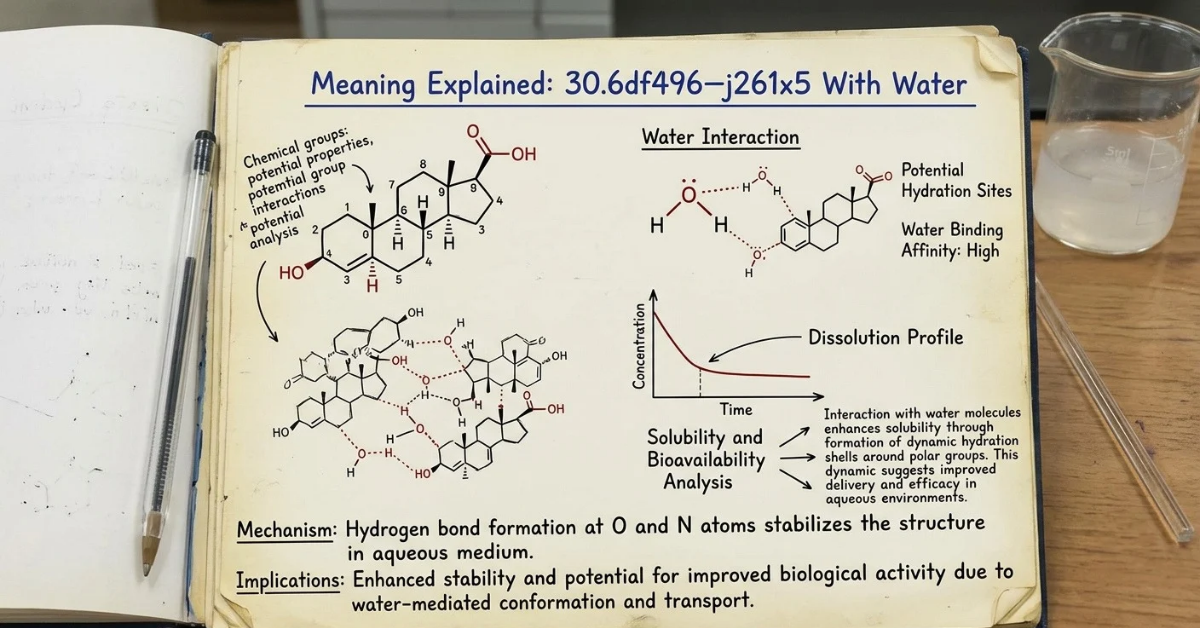
Some search terms look like they belong in a chemistry textbook even when they do not. 30.6df496–j261x5 with water is one of those unusual phrases. It combines numbers, letters, punctuation, and the ordinary word “water,” making it easy to wonder whether it refers to a chemical mixture, product, ingredient, laboratory substance, or technical formula.
- What Is 30.6df496–j261x5?
- What Does “With Water” Mean?
- Why Does 30.6df496–j261x5 Look Like a Scientific Code?
- Is 30.6df496–j261x5 a Product?
- Could It Be a Batch or Tracking Code?
- Can You Mix 30.6df496–j261x5 With Water?
- Is 30.6df496–j261x5 Safe With Water?
- How to Verify an Unknown Code
- Common Misunderstandings About 30.6df496–j261x5
- Why Context Matters More Than the Code
- What Should You Do If You Encounter It?
- Frequently Asked Questions
- Conclusion
The important point is that there is currently no clearly established public definition identifying 30.6df496–j261x5 as a specific substance. Recent online references generally treat the string as an unidentified or potentially system-generated identifier rather than a recognized chemical or ingredient.
So, before trying to mix anything with water based solely on this phrase, it is worth understanding what the code actually tells us—and what it does not.
What Is 30.6df496–j261x5?
At first glance, 30.6df496–j261x5 looks technical. However, its unusual appearance does not automatically mean that it is a chemical compound or scientific formula.
The string contains several recognizable elements:
- 30 – a numerical component
- . – a decimal point
- 6df496 – a mixture of numbers and letters
- – – a separator
- j261x5 – another mixed alphanumeric sequence
This type of structure can occur in automatically generated identifiers, database references, software records, inventory systems, tracking codes, or internal technical labels.
Several sources that have examined the term similarly conclude that its exact meaning cannot be established from the characters alone.
Is It a Chemical Name?
There is no reliable evidence showing that 30.6df496–j261x5 is a recognized chemical name.
Chemical substances are normally identified using established names, molecular formulas, CAS Registry Numbers, systematic nomenclature, or other recognized identifiers. A string such as 30.6df496–j261x5 does not, by itself, provide enough information to determine a substance’s molecular structure, concentration, properties, or hazards.
That distinction matters because a code that looks scientific is not necessarily a scientific substance.
What Does “With Water” Mean?
The addition of “with water” creates another layer of confusion.
If someone searches for 30.6df496–j261x5 with water, they may assume that the term describes something that should be dissolved, diluted, consumed, cleaned with, or otherwise combined with water.
There is currently no reliable evidence establishing a standard water mixture associated with this identifier. Some online pages speculate about water-quality testing, industrial processes, moisture readings, or other technical contexts, but those interpretations are not enough to establish a confirmed meaning.
In other words, “with water” does not prove that the code represents something that should be added to water.
Why Does 30.6df496–j261x5 Look Like a Scientific Code?
The human brain naturally looks for patterns. When we see a combination such as 30.6df496–j261x5, it can resemble:
- A chemical identifier
- A laboratory reference
- A product number
- A software build
- A batch code
- A database ID
- A technical measurement
- A model number
Many legitimate systems use combinations of letters and numbers in exactly this general way.
For example, a manufacturer might use an internal code to identify a production batch, while software could generate a unique identifier for a particular record. The visual format alone cannot tell us which explanation applies.
One important principle is therefore worth remembering: similar-looking identifiers can have completely different meanings in different systems.
Is 30.6df496–j261x5 a Product?
Based on currently available public information, there is no strong evidence establishing 30.6df496–j261x5 as a recognized consumer product.
If you encountered it on packaging, an online store, an invoice, a technical document, or a website, the surrounding information is much more useful than the code itself.
Look for:
- The manufacturer’s name
- A product or model name
- An official website
- Instructions for use
- A product specification sheet
- A batch or lot number
- A customer-support reference
- Relevant safety documentation
These details can help establish what the identifier represents.
Could It Be a Batch or Tracking Code?
Yes, that is one possible explanation—but it should be described as a possibility, not a confirmed fact.
Modern manufacturing and logistics systems frequently use identifiers to distinguish products, shipments, production runs, samples, and records. Such codes can be meaningless to consumers while being highly useful to the company that generated them.
For example, an internal system might associate a code with:
- A production batch
- A warehouse record
- A laboratory sample
- A shipment
- A quality-control test
- A software transaction
- An inventory item
The actual meaning would depend on the system that created the code.
Can You Mix 30.6df496–j261x5 With Water?
Do not assume that you can.
The phrase itself does not provide instructions about dosage, concentration, solubility, temperature, compatibility, or safety. If you have encountered the identifier on a physical product, mixing it with water should only be considered after identifying the actual substance or product and checking its manufacturer’s instructions.
This is particularly important if the material could be chemical, industrial, pharmaceutical, laboratory-related, or otherwise unidentified.
A mysterious code is not enough information to establish that a substance is safe for drinking, cooking, cleaning, skin contact, or household use.
Is 30.6df496–j261x5 Safe With Water?
There is not enough verified information to make a safety determination about an unidentified substance.
Water itself is familiar and generally safe when it meets appropriate drinking-water standards, but that does not mean an unknown material is automatically safe when combined with it.
The safety of a mixture depends on factors such as:
- The actual identity of the material
- Its concentration
- Its intended application
- Chemical compatibility
- Temperature
- pH
- Exposure route
- Manufacturer instructions
- Relevant safety documentation
Therefore, if the phrase appears on a container containing an unknown substance, identify the product first rather than experimenting with water.
How to Verify an Unknown Code
If you genuinely need to identify 30.6df496–j261x5, the best approach is to work backward from its original source.
1. Check Where You Found It
Was the code shown on:
- A bottle?
- Food packaging?
- A website?
- A software application?
- A laboratory document?
- An invoice?
- A shipping label?
- A screenshot?
The location can immediately narrow down the possibilities.
2. Look for Nearby Information
Codes rarely appear completely alone. Check for a brand name, barcode, QR code, model number, ingredients, instructions, or document title.
3. Search the Exact String
Use the exact spelling and punctuation. Small differences can matter when dealing with automatically generated identifiers.
Try searches such as:
"30.6df496-j261x5""30.6df496 j261x5""30.6df496–j261x5" water"30.6df496–j261x5" product
4. Contact the Original Source
If the identifier appears on a product, the manufacturer or supplier is usually in a much better position to explain it.
5. Don’t Guess From Appearance
A technical-looking code does not prove that something is a chemical, medicine, supplement, food additive, or scientific compound.
Common Misunderstandings About 30.6df496–j261x5
Several assumptions can arise when people encounter an unfamiliar code.
“It must be a chemical.”
Not necessarily. The structure does not establish a chemical identity.
“Adding water will activate it.”
There is no verified evidence supporting that conclusion.
“It must be a food ingredient.”
There is no established evidence that 30.6df496–j261x5 is a food ingredient or additive. Recent articles discussing the phrase similarly caution against treating it as a consumable substance.
“The numbers must contain a hidden formula.”
There is no reliable basis for assuming that. Alphanumeric identifiers are often generated for organizational purposes rather than mathematical or chemical meaning.
Why Context Matters More Than the Code
The biggest lesson from 30.6df496–j261x5 with water is that an identifier cannot always be interpreted in isolation.
Imagine finding a code on a bottle. The code might identify the production batch. Find the same-looking format in computer software, however, and it could represent a completely unrelated record.
That is why responsible identification starts with source and context, not speculation.
What Should You Do If You Encounter It?
If you see 30.6df496–j261x5 online, there is generally no reason to assume it represents something dangerous or useful simply because it looks complicated.
If you see it associated with a physical substance, however, take a more cautious approach:
- Don’t ingest an unidentified substance.
- Don’t mix it with water without verified instructions.
- Check the original packaging or documentation.
- Identify the manufacturer or source.
- Look for an official product or safety document.
- Ask the manufacturer if the code remains unclear.
This approach is much more reliable than trying to decode the characters by appearance.
Frequently Asked Questions
What is 30.6df496–j261x5?
30.6df496–j261x5 appears to be an unusual alphanumeric identifier or reference string. Its exact origin and purpose cannot currently be established from the code alone.
Is 30.6df496–j261x5 a chemical?
There is no reliable evidence establishing it as a recognized chemical compound. Its format is more consistent with an identifier than a conventional chemical name.
What does 30.6df496–j261x5 with water mean?
The phrase does not have a confirmed standard scientific meaning. “With water” may simply reflect the context in which people are searching for the identifier, rather than describing a recognized mixture.
Can you drink 30.6df496–j261x5 with water?
No consumption recommendation can safely be made from this identifier alone. If it refers to a physical substance, the substance should first be positively identified and its official usage instructions checked.
Is 30.6df496–j261x5 a food ingredient?
There is currently no reliable evidence establishing it as a recognized food ingredient, additive, preservative, or flavoring.
Why does the code contain letters and numbers?
Many computer-generated identifiers use mixed letters and numbers to create unique references. However, the structure of this particular code does not reveal which system generated it.
Should I mix an unknown code with water?
No. An unidentified material should not be mixed with water merely because an online search contains the phrase “with water.” Verify the substance and follow authoritative instructions first.
Conclusion
30.6df496–j261x5 with water sounds like it should have a precise scientific explanation, but the available evidence does not establish it as a recognized chemical, ingredient, medicine, or consumer product. The string is better treated as an unidentified or context-dependent alphanumeric identifier until its original source provides more information.
The safest way to investigate it is simple: find where the code came from, examine the surrounding information, and verify it with the original manufacturer, platform, or document. Most importantly, don’t assume that an unfamiliar identifier is something that should be mixed with water or consumed.
If you encountered 30.6df496–j261x5 with water on a specific product, label, website, or screenshot, that original context is the key to determining what the code actually means.



Leave a Reply