Artificial intelligence is no longer something companies can simply “experiment with.” It is already changing how organizations make decisions, serve customers, manage employees, analyze data, and build products.
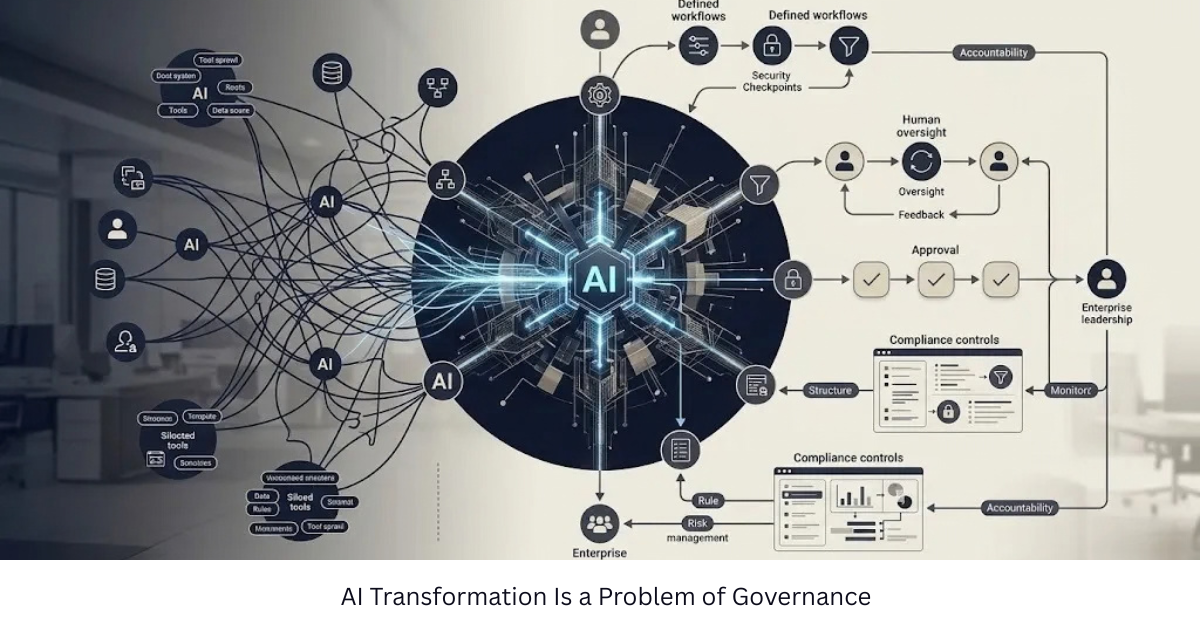
Yet there is an uncomfortable truth behind the AI boom: AI transformation is a problem of governance as much as it is a technology problem.
Buying an AI tool is relatively easy. Deploying a chatbot, connecting an AI model to company data, or giving employees access to generative AI can happen within days. The difficult questions come afterward.
Who is responsible when an AI system makes a bad decision? Who checks whether the data is reliable? What information can employees put into an AI tool? When should a human override an automated recommendation? And who decides whether an AI application should be deployed in the first place?
These are governance questions.
As AI adoption accelerates, organizations increasingly need structures that connect technology with accountability, risk management, business strategy, and human judgment.
Why AI Transformation Is More Than a Technology Project
Traditional technology projects usually have relatively clear boundaries.
A company implements a CRM system, upgrades its servers, or moves applications to the cloud. There are defined requirements, implementation milestones, security controls, and performance metrics.
AI is different because its behavior can depend on data, context, models, prompts, users, and changing environments.
An AI system can also influence decisions rather than simply execute predefined instructions.
That creates a different management challenge.
Stanford’s 2026 AI Index reports that organizational AI adoption continued to rise in 2025, with 88% of surveyed organizations reporting AI use in at least one business function. At the same time, responsible AI maturity remains an ongoing challenge.
The implication is important: organizations are adopting AI faster than many of them are developing mature systems for governing it.
Technology creates the capability. Governance determines how that capability is used.
The Real AI Governance Challenge
AI governance is sometimes misunderstood as a collection of legal policies or compliance documents.
It is much broader.
Effective governance establishes how an organization makes decisions about AI throughout its lifecycle—from selecting a system to deploying it, monitoring it, updating it, and eventually retiring it.
A practical AI governance framework should answer questions such as:
- What AI systems are we using?
- What business problem is each system solving?
- What data does it access?
- Who owns the system?
- What risks could it create?
- Who is accountable for its outputs?
- What level of human oversight is required?
- How are errors reported and corrected?
- How do we measure whether the system is actually delivering value?
Without clear answers, AI adoption can become fragmented.
One department may use an AI tool for customer service, another may use it for recruitment, and another may feed confidential documents into a public AI platform—all without a common set of rules.
That is not transformation. It is uncontrolled adoption.
AI Risk Management Needs to Be Continuous
One of the most useful ways to think about AI governance is as an ongoing process rather than a one-time approval.
NIST’s AI Risk Management Framework organizes AI risk management around four functions: Govern, Map, Measure, and Manage. Importantly, NIST treats governance as a cross-cutting function that should influence the rest of the AI lifecycle.
This approach makes sense because AI risks can change after deployment.
For example, a model may perform well during testing but produce unexpected results when:
- The underlying data changes
- Users interact with it in unexpected ways
- The business changes its processes
- The model is updated
- A third-party provider changes its service
- Attackers discover a new vulnerability
- Regulations change
Governance therefore cannot stop when an AI product goes live.
Organizations need continuous monitoring, testing, documentation, incident reporting, and periodic review.
The Accountability Problem
Perhaps the biggest question in AI transformation is deceptively simple:
Who is accountable?
When a human employee makes a decision, organizations generally know where responsibility sits. There may be managers, policies, review processes, and established disciplinary or legal mechanisms.
AI complicates that chain of responsibility.
Suppose an AI-supported recruitment system consistently disadvantages a particular group of applicants. Is the problem with the vendor? The training data? The company’s configuration? The HR department? The employee who relied on the recommendation?
If nobody owns the decision, responsibility can disappear into the technology.
That is why AI governance needs clearly defined roles.
A company might establish responsibility across several areas:
- Executive leadership — sets organizational priorities and risk tolerance.
- Technology teams — manage technical implementation and security.
- Legal and compliance teams — interpret regulatory obligations.
- Business owners — define the purpose and acceptable use of each system.
- Risk teams — assess potential harms and controls.
- Employees and users — follow policies and report problems.
- Senior oversight bodies — review significant AI risks and strategic decisions.
The exact structure will vary by organization. The important point is that responsibility should be explicit rather than assumed.
Human Oversight Is Not a Checkbox
The phrase “human in the loop” has become common in AI discussions.
But simply placing a human somewhere in the process does not automatically create meaningful oversight.
Imagine an employee receiving hundreds of AI-generated recommendations every day. If the organization expects that person to approve each recommendation in seconds, the human may effectively become a rubber stamp.
Real human oversight requires:
- Appropriate training
- Sufficient time for review
- Access to relevant information
- Authority to reject AI recommendations
- Clear escalation procedures
- Monitoring of human overrides
- Accountability for both automated and human decisions
The goal is not to keep humans involved merely for appearances.
The goal is to ensure that humans retain meaningful authority where judgment, context, ethics, or accountability matter.
Data Governance Is at the Center of AI Transformation
AI systems are only as reliable as the information and processes surrounding them.
That makes data governance one of the foundations of successful AI adoption.
Organizations need to understand:
- Where their data comes from
- Whether they have permission to use it
- How accurate it is
- How sensitive it is
- Who can access it
- How long it should be retained
- Whether it contains bias or gaps
- How it is transferred to AI vendors
This becomes particularly important with generative AI.
An employee might paste customer information, financial records, confidential contracts, or proprietary product information into an AI application without realizing the potential consequences.
A useful AI policy therefore should not simply say “don’t misuse AI.”
It should explain what employees can do, what they cannot do, which tools are approved, what information is restricted, and when human review is mandatory.
AI Governance and Cybersecurity Are Becoming Connected
AI also changes the cybersecurity equation.
Organizations are using AI to detect threats, analyze security events, automate responses, and improve defensive operations.
At the same time, AI systems themselves introduce new attack surfaces.
Examples include:
- Prompt injection
- Data poisoning
- Model manipulation
- Unauthorized data exposure
- Excessive AI permissions
- Supply-chain vulnerabilities
- Automated phishing and social engineering
This means AI governance cannot operate in isolation from information security.
Security teams need visibility into what AI systems exist, what data they access, what external services they connect to, and what permissions they have.
The more autonomous an AI system becomes, the more important those controls become.
Regulation Is Pushing Governance Up the Agenda
Governments are increasingly treating AI governance as an institutional issue rather than simply a technology issue.
The OECD emphasizes risk-based and interoperable approaches to AI governance, while its recent work on AI in government identifies governance, data, digital infrastructure, skills, investment, procurement, and partnerships as important enablers.
The European Union’s AI Act also establishes a governance architecture involving the European AI Office, national authorities, the European AI Board, scientific experts, and other stakeholders.
For organizations operating internationally, this matters.
AI policies cannot be designed purely around what a technology can do. Companies increasingly need to consider where the system is deployed, what type of AI application it is, what risks it presents, and which regulatory requirements apply.
Regulation will differ between jurisdictions, but the broader direction is clear: accountability around AI is becoming an organizational responsibility.
Why AI Projects Fail Without Governance
Many organizations approach AI transformation from the wrong starting point.
They ask:
“Where can we use AI?”
A better question is:
“Where can AI create measurable value within an acceptable risk boundary?”
That small change in wording can significantly improve decision-making.
Without governance, companies can encounter several problems.
1. AI Tool Sprawl
Different departments adopt different AI applications without central visibility.
The result can be duplicated spending, inconsistent security standards, and uncontrolled data flows.
2. Poor Business Alignment
Employees may use AI because it is fashionable rather than because it solves a meaningful business problem.
AI adoption then becomes an activity rather than a transformation strategy.
3. Hidden Operational Risk
An AI system may quietly influence important decisions without appropriate monitoring.
The problem might only become visible after customers, employees, or regulators raise concerns.
4. Unclear Accountability
When something goes wrong, teams may not know who owns the problem.
That slows down response and makes it harder to learn from incidents.
5. Loss of Trust
Customers and employees are more likely to resist AI when they cannot understand how it affects them.
Trust is not created by saying that an AI system is “safe.” It is created through transparency, accountability, appropriate controls, and demonstrated reliability.
Building a Practical AI Governance Framework
Organizations do not necessarily need a massive bureaucracy to govern AI effectively.
A practical framework can begin with a few fundamental steps.
Step 1: Create an AI Inventory
Identify every significant AI system currently being used.
Record:
- Purpose
- Vendor
- Data involved
- Business owner
- Users
- Risk level
- External integrations
- Regulatory considerations
You cannot govern what you cannot see.
Step 2: Classify AI Use Cases by Risk
Not every AI application deserves the same level of oversight.
An AI tool generating internal meeting summaries presents a different risk profile from a system influencing employment, lending, healthcare, or access to essential services.
Risk-based governance allows organizations to focus their strongest controls where potential harm is greatest.
Step 3: Assign Clear Ownership
Every important AI system should have an identifiable business owner.
That owner should understand what the system does, why it exists, what its limitations are, and what happens when it fails.
Step 4: Establish Data Rules
Create clear policies covering sensitive information, customer data, intellectual property, personal information, and third-party AI services.
Employees should not have to guess what information is safe to enter into an AI tool.
Step 5: Build Testing and Monitoring Into the Lifecycle
AI should be evaluated before deployment and monitored afterward.
Testing can examine:
- Accuracy
- Reliability
- Bias
- Security
- Privacy
- Explainability
- Robustness
- Failure scenarios
NIST specifically emphasizes incorporating trustworthiness considerations throughout the AI lifecycle rather than treating them as a final-stage activity.
Step 6: Create an Incident Process
Organizations should decide in advance what happens when an AI system behaves unexpectedly.
A useful process should define:
- How incidents are detected
- Who receives the alert
- Who can suspend the system
- How affected people are identified
- How the root cause is investigated
- How corrective action is documented
This turns AI governance from a policy document into an operational capability.
Governance Should Enable Innovation, Not Stop It
There is a legitimate concern that excessive governance could slow down innovation.
That concern should not be dismissed.
If every low-risk experiment requires weeks of approval, employees may avoid experimentation altogether. On the other hand, having no controls can expose an organization to unnecessary financial, legal, security, and reputational risks.
The answer is proportional governance.
Low-risk applications can have lightweight controls.
Higher-risk applications should receive deeper assessment, testing, documentation, and human oversight.
The OECD has similarly emphasized proportionate, risk-based guardrails so that governance does not become a reason for unnecessary inaction.
Good governance should create safe space for experimentation, not eliminate experimentation.
The Role of Leadership in AI Transformation
AI transformation ultimately reaches beyond IT.
Executives need to decide what the organization wants AI to accomplish and what boundaries should exist around its use.
That requires conversations about:
- Business strategy
- Workforce changes
- Customer experience
- Data ownership
- Risk tolerance
- Regulatory exposure
- Organizational culture
- Investment priorities
Leadership also sets the tone.
If executives demand rapid AI adoption while ignoring security, documentation, or accountability, employees receive a clear message about what the organization actually values.
Conversely, when leadership treats responsible AI as part of business performance rather than an obstacle to it, governance becomes easier to embed into everyday operations.
The Future of AI Belongs to Governed Systems
The next phase of AI adoption is unlikely to be defined simply by who has access to the most powerful models.
It will increasingly depend on how organizations integrate those models into real-world systems.
A powerful model connected to poor data, unclear permissions, weak oversight, and badly designed processes can create more problems than value.
A less spectacular model, deployed for a clearly defined purpose with strong controls and measurable outcomes, can be far more useful.
This is why governance matters.
AI transformation is not simply about automating work. It is about changing how decisions are made, how information moves through an organization, and how responsibility is distributed.
Technology provides the engine.
Governance provides the steering wheel, brakes, and rules of the road.
Frequently Asked Questions
What does AI governance mean?
AI governance refers to the policies, processes, roles, controls, and oversight mechanisms used to manage the development and use of artificial intelligence.
It covers areas such as accountability, data management, security, risk assessment, transparency, human oversight, compliance, and monitoring.
Why is governance important for AI transformation?
Because AI can affect decisions, employees, customers, data, and business processes. Governance helps organizations determine where AI should be used, what risks are acceptable, who is responsible, and how systems should be monitored.
Is AI governance only about compliance?
No. Compliance is one part of AI governance.
Effective governance also supports business strategy, cybersecurity, data quality, operational risk management, responsible innovation, and organizational accountability.
Who should be responsible for AI governance?
There is no universal organizational structure.
Depending on the company’s size and industry, responsibility may involve executive leadership, IT, security, legal, compliance, risk management, data teams, business units, and dedicated AI governance roles.
The important principle is that responsibilities should be clearly defined.
What is responsible AI?
Responsible AI generally refers to developing and using AI in ways that address issues such as safety, security, privacy, fairness, transparency, accountability, and reliability.
NIST’s AI Risk Management Framework provides one established approach for incorporating these considerations into AI development and deployment.
Can AI governance slow down innovation?
It can if governance is unnecessarily bureaucratic.
However, risk-based governance can do the opposite. By establishing clear rules and approval paths, organizations can make it easier for employees to experiment while applying stronger controls to higher-risk applications.
What should companies do first when starting AI governance?
Start with visibility.
Create an inventory of AI systems and use cases, identify the data they use, assign owners, and classify them according to risk.
From there, organizations can build appropriate policies, controls, monitoring, and review processes.
Conclusion: AI Transformation Requires Better Governance
The AI conversation often focuses on models, automation, productivity, and competitive advantage.
Those things matter. But they are only part of the story.
The harder challenge is deciding how AI should operate inside an organization—and who remains accountable when it does not behave as expected.
That is why AI transformation is a problem of governance as much as technology.
Organizations that want sustainable AI adoption need more than new tools. They need clear ownership, reliable data practices, human oversight, risk management, security controls, continuous monitoring, and leadership that understands both the opportunities and the responsibilities involved.
The practical next step is not necessarily to buy another AI tool.
It is to map the AI tools you already have, identify where they influence important decisions, assess the risks, and build governance around them.
AI can transform an organization.
But whether that transformation creates lasting value depends largely on how well the organization governs it.



Leave a Reply