When your skin is sensitive, choosing a moisturizer can feel surprisingly complicated. A cream that leaves one person’s skin soft and comfortable may cause another person to experience stinging, redness, or dryness.
- NIVEA vs Aveeno for Sensitive Skin: What Is the Difference?
- How Gentle Are NIVEA Creams for Sensitive Skin?
- Is Aveeno More Gentle Than NIVEA?
- Fragrance Matters More Than the Brand Name
- NIVEA vs Aveeno: A Simple Comparison
- Which Ingredients Can Help Sensitive Skin?
- What If My Sensitive Skin Is Also Acne-Prone?
- How to Test a New Moisturizer on Sensitive Skin
- How to Use Moisturizer on Sensitive Skin
- So, Which One Should You Try?
- Frequently Asked Questions
- Final Thoughts
If you’re wondering, “I have sensitive skin. How gentle are NIVEA’s creams compared to Aveeno?”, the answer depends largely on the specific product, not just the brand. Both NIVEA and Aveeno make moisturizers designed for sensitive skin, but their formulas can differ considerably in fragrance, soothing ingredients, texture, and the way they support the skin barrier.
For sensitive skin, dermatologists generally recommend looking for a fragrance-free moisturizer, particularly if you are prone to eczema or irritation.
NIVEA vs Aveeno for Sensitive Skin: What Is the Difference?
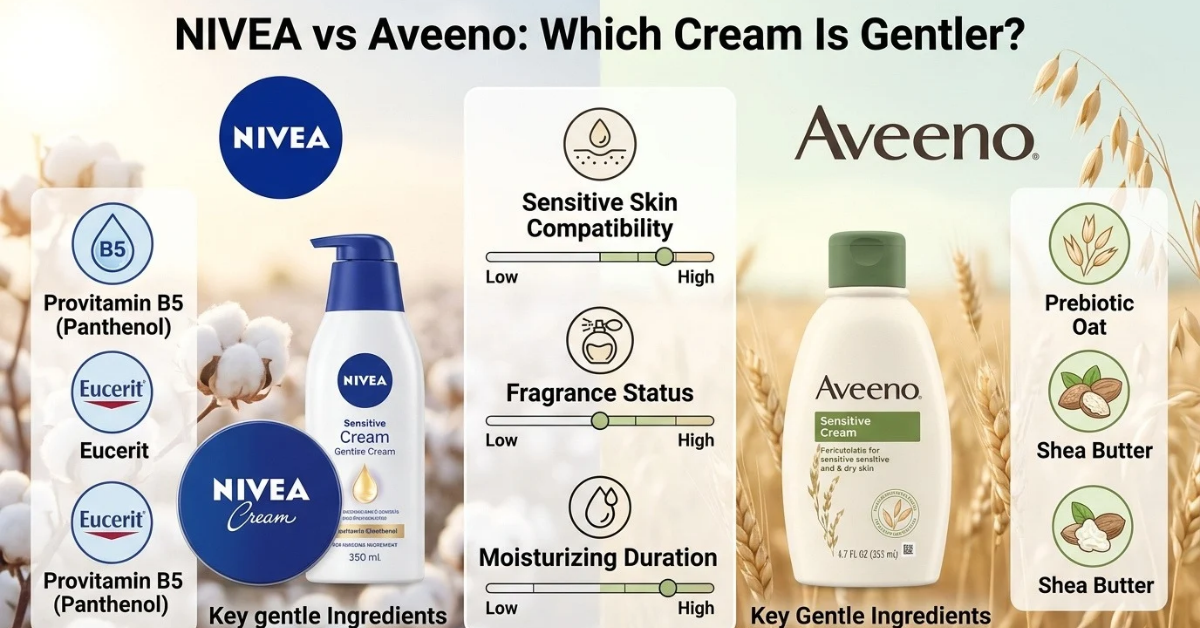
NIVEA and Aveeno both offer products specifically marketed for sensitive skin. However, Aveeno has a particularly strong focus on oat-based skincare, while NIVEA’s sensitive-skin range uses ingredients such as panthenol, glycerin, shea butter, and licorice extract, depending on the product.
For example, NIVEA’s Soothing Night Face Cream is currently listed as perfume-free and contains panthenol, glycerin, shea butter, and licorice extract.
Aveeno’s regular cream for dry and sensitive skin contains colloidal oatmeal, glycerin, dimethicone, mineral oil, allantoin, and other moisturizing ingredients.
That doesn’t automatically make one brand universally gentler. Sensitive skin can react differently to individual ingredients, so checking the complete ingredient list is more useful than choosing a brand based solely on its reputation.
How Gentle Are NIVEA Creams for Sensitive Skin?
NIVEA has several products formulated specifically for sensitive skin. One example is its Soothing Night Face Cream, which is described by the manufacturer as suitable for sensitive skin and free from perfume.
Its formula includes ingredients such as:
- Glycerin – helps attract and retain water in the skin.
- Shea butter – provides emollient moisturization.
- Panthenol – commonly used to condition and soothe the skin.
- Licorice extract – included in the formula for its skin-soothing properties.
- Cetearyl alcohol – a fatty alcohol used to give creams their texture and conditioning properties.
NIVEA also offers a Sensitive Day Cream SPF 15 that is listed as perfume-free and formulated for sensitive skin.
So, NIVEA can be a gentle option when you select one of its fragrance-free sensitive-skin formulas.
The important part is not assuming that every NIVEA cream has the same formulation. The brand has a large range, and some products may contain fragrance or other ingredients that aren’t ideal for particularly reactive skin.
Is Aveeno More Gentle Than NIVEA?
Aveeno is well known for using oat-based ingredients, particularly colloidal oatmeal, in products intended for dry and sensitive skin.
Its standard Aveeno Cream is specifically described as being suitable for dry and sensitive skin and contains colloidal oatmeal.
Some Aveeno facial products take the sensitive-skin approach even further. For example, the brand’s Calm + Restore Oat Rich Cream is marketed for dry to very dry sensitive skin and is described as fragrance-free, hypoallergenic, dermatologist tested, and non-comedogenic.
Aveeno’s Calm + Restore range therefore offers several characteristics that people with reactive skin commonly look for.
However, “more gentle” isn’t a universal scientific ranking between Aveeno and NIVEA. A person may tolerate a particular NIVEA formula perfectly well while reacting to an Aveeno product, or vice versa.
Fragrance Matters More Than the Brand Name
If your skin is easily irritated, one of the first things to check is fragrance.
The American Academy of Dermatology recommends choosing fragrance-free products for dry or sensitive skin. It also points out an important distinction: “unscented” does not necessarily mean fragrance-free.
Fragrance can be particularly problematic for people with eczema or very reactive skin.
That’s why it is worth checking the label rather than assuming a moisturizer is gentle because it says “sensitive” on the packaging.
What to Look For
When comparing NIVEA and Aveeno, look for:
- Fragrance-free formulas
- Ingredients that support the skin barrier
- Glycerin and other humectants
- Emollients that soften dry skin
- Minimal potential irritants if your skin is highly reactive
- Products specifically formulated for sensitive skin
- Non-comedogenic formulas if you’re also prone to clogged pores
Remember that fragrance-free is not the same as ingredient-free. A sensitive-skin product can still contain numerous ingredients, and you may personally react to one of them.
NIVEA vs Aveeno: A Simple Comparison
| Feature | NIVEA Sensitive Creams | Aveeno Sensitive-Skin Creams |
| Sensitive-skin options | Yes | Yes |
| Fragrance-free options | Yes | Yes |
| Oat-based formulas | Not the main focus | Major feature |
| Panthenol | Found in some formulas | Found in some formulas |
| Glycerin | Common | Common |
| Barrier moisturization | Yes | Yes |
| Hypoallergenic options | Depends on product | Several products are labeled hypoallergenic |
| Best approach | Check individual formula | Check individual formula |
The biggest takeaway is simple: compare the exact cream rather than comparing NIVEA and Aveeno as entire brands.
Which Ingredients Can Help Sensitive Skin?
A gentle moisturizer doesn’t need an enormous ingredient list. Several basic moisturizing ingredients can be useful for dry, sensitive skin.
Glycerin
Glycerin is a humectant that helps attract water to the outer layers of the skin. It is commonly found in moisturizers for dry skin.
Colloidal Oatmeal
Colloidal oatmeal is one of Aveeno’s signature ingredients. Aveeno uses oat-based ingredients in several products designed for dry and sensitive skin.
Panthenol
Panthenol is used in some NIVEA sensitive-skin products and can help condition and moisturize the skin. NIVEA’s Soothing Night Face Cream, for example, contains panthenol.
Shea Butter
Shea butter provides an emollient effect and is found in sensitive-skin formulas from both brands. It can be particularly useful when skin feels rough, tight, or dry.
Dimethicone
Dimethicone is a silicone-based skin-conditioning ingredient that can help reduce water loss and leave skin feeling smoother. It appears in Aveeno’s standard cream and Calm + Restore Oat Rich Cream.
What If My Sensitive Skin Is Also Acne-Prone?
Sensitive skin and acne-prone skin can occur together, which makes moisturizer selection slightly trickier.
A rich cream may feel excellent on dry cheeks but feel heavy around the forehead, nose, or chin. In that situation, you don’t necessarily need to moisturize your entire face with the same amount of product.
The American Academy of Dermatology notes that people with dry skin should consider moisturizers that are non-comedogenic, meaning they are less likely to clog pores.
If you’re acne-prone, look for:
- A fragrance-free moisturizer.
- A non-comedogenic label where available.
- A texture that feels comfortable rather than greasy.
- Ingredients that hydrate without causing breakouts for you personally.
How to Test a New Moisturizer on Sensitive Skin
Even a product marketed for sensitive skin can cause a reaction in an individual.
The American Academy of Dermatology recommends testing new skincare products before applying them broadly. For people with eczema-prone skin, its guidance suggests applying the product to a small area of the inner arm daily for 7–10 days and observing the skin.
A simple approach is:
- Apply a small amount to a limited area.
- Don’t introduce several new skincare products at the same time.
- Watch for burning, itching, swelling, redness, or a rash.
- Stop using the product if you develop a significant reaction.
- Seek medical advice if the reaction is persistent or severe.
This is especially useful when you already know that your skin reacts easily.
How to Use Moisturizer on Sensitive Skin
Timing can make a difference too.
Dermatologists generally recommend applying moisturizer soon after bathing or washing while the skin is still slightly damp. This helps trap moisture before it evaporates.
For a simple routine:
Morning:
Gentle cleanser → moisturizer → broad-spectrum SPF 30+
Evening:
Gentle cleanser → moisturizer
You don’t need a complicated 10-step routine. In fact, reducing the number of products you use can make it easier to identify what is irritating your skin.
So, Which One Should You Try?
If your main concern is very reactive, dry, or eczema-prone skin, you may want to start by looking at a fragrance-free formula specifically designed for sensitive skin.
Aveeno’s sensitive-skin range is particularly worth considering if you are interested in oat-based moisturizers, while NIVEA has fragrance-free sensitive-skin options containing ingredients such as panthenol, glycerin, shea butter, and licorice extract.
Rather than choosing solely between the two brands, compare the individual product’s:
- Fragrance status
- Ingredient list
- Intended skin type
- Texture
- Non-comedogenic claims
- Your own previous reactions
That approach is much more reliable for sensitive skin.
Frequently Asked Questions
Is NIVEA good for sensitive skin?
Some NIVEA products are specifically formulated for sensitive skin. For example, NIVEA’s Soothing Night Face Cream is listed as perfume-free and contains panthenol and licorice extract. However, NIVEA has many different products, so the individual formula matters.
Is Aveeno better for very sensitive skin?
Aveeno offers several products specifically formulated for sensitive skin, including fragrance-free options containing oat-based ingredients. However, “better” depends on your individual skin and which specific formula you tolerate.
Is NIVEA or Aveeno better for dry skin?
Both brands make moisturizers for dry skin. Aveeno’s standard cream contains colloidal oatmeal, while NIVEA’s sensitive formulas can contain ingredients such as glycerin, shea butter, and panthenol. Your preferred texture and individual tolerance should guide the choice.
Should sensitive skin avoid fragrance?
If your skin is sensitive or eczema-prone, fragrance-free products are generally the safer starting point. The American Academy of Dermatology specifically recommends fragrance-free skincare for sensitive and eczema-prone skin.
Can sensitive skin use NIVEA cream every day?
A suitable NIVEA sensitive-skin moisturizer can be used daily according to its directions. Start gradually if you’re unsure how your skin will react, and stop if you develop irritation.
Can Aveeno cause irritation?
Yes. Even gentle or sensitive-skin products can cause irritation or allergic reactions in some individuals. “Sensitive skin” and “hypoallergenic” do not guarantee that a particular product will work for everyone.
Is fragrance-free the same as hypoallergenic?
No. Fragrance-free means the product does not contain added fragrance ingredients. Hypoallergenic generally means the manufacturer has formulated the product to reduce the likelihood of an allergic reaction, but it does not guarantee that no one will react.
Final Thoughts
If you’re asking, “I have sensitive skin. How gentle are NIVEA’s creams compared to Aveeno?”, neither brand can be declared universally gentler for every person.
Both offer sensitive-skin moisturizers, but their formulations differ. Aveeno stands out for its use of oat-based ingredients in many sensitive-skin products, while NIVEA has fragrance-free sensitive formulas featuring ingredients such as glycerin, panthenol, shea butter, and licorice extract.
For particularly reactive skin, focus less on the brand name and more on the exact ingredient list. A fragrance-free cream with a simple, moisturizing formula is usually a sensible place to start, and patch testing can help you discover what your own skin tolerates.
If your skin frequently burns, develops rashes, becomes painfully dry, or reacts to many skincare products, a dermatologist can help identify whether you’re dealing with simple sensitivity, eczema, contact dermatitis, rosacea, or another skin condition.



Leave a Reply