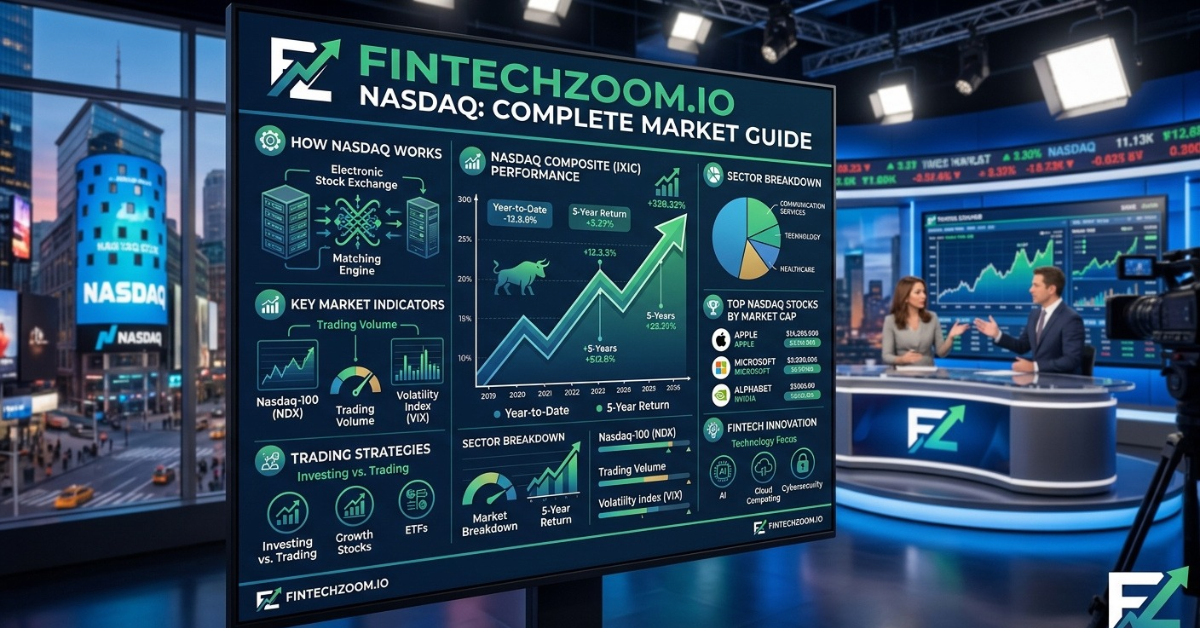
Searching for fintechzoom.io nasdaq can lead to a confusing mix of financial information, stock-market commentary, charts, and Nasdaq-related content. However, one important distinction should be made right away: FintechZoom.io and Nasdaq are not the same organization.
FintechZoom.io presents itself as a financial-information platform covering markets such as Nasdaq, Dow Jones, stocks, cryptocurrency, and other financial topics. Meanwhile, Nasdaq operates major securities markets and provides indexes, market data, listings, and financial-technology services.
So, what exactly does the term “FintechZoom.io Nasdaq” mean? Is it a stock, an index, or a Nasdaq service? More importantly, how should readers use the financial information they find through the platform?
Let’s break it down.
What Is FintechZoom.io Nasdaq?
FintechZoom.io Nasdaq generally refers to Nasdaq-related market coverage available through FintechZoom.io.
The phrase is not the name of a separate stock, exchange, or Nasdaq index. Instead, it describes content associated with Nasdaq, including information about technology companies, stock-market movements, earnings, trends, and broader financial analysis.
For example, FintechZoom.io’s website includes Nasdaq among the markets it covers. Therefore, readers searching for this phrase are usually looking for Nasdaq-related articles, analysis, or market information.
A simple way to understand the relationship is:
- FintechZoom.io: A financial-information and market-content website.
- Nasdaq: A major U.S. securities-market operator and financial-technology company.
- Nasdaq indexes: Benchmarks such as the Nasdaq Composite and Nasdaq-100.
- FintechZoom.io Nasdaq: A search phrase referring to Nasdaq-related information found through FintechZoom.io.
This distinction matters because reading about a market on a website does not mean that the website operates that market.
What Is Nasdaq?
Nasdaq is much more than a stock-market ticker or a single index.
The Nasdaq Stock Market is a major electronic securities marketplace. At the same time, Nasdaq as a company provides market infrastructure, data, indexes, listings, and financial-technology solutions.
When people say “Nasdaq,” they may actually be referring to several different things.
1. Nasdaq Stock Market
First, the Nasdaq Stock Market is the securities marketplace where listed companies’ shares can be traded.
As a result, the term “Nasdaq” is sometimes used informally when people are actually talking about the exchange itself.
2. Nasdaq, Inc.
Nasdaq, Inc. is the publicly traded company behind the broader Nasdaq business. Its activities include market infrastructure, financial technology, data, and related services.
Therefore, Nasdaq, Inc. should not automatically be confused with the Nasdaq Composite or Nasdaq-100 indexes.
3. Nasdaq Indexes
Nasdaq also maintains numerous indexes used to track groups of securities and particular market themes.
For instance, the Nasdaq Composite and Nasdaq-100 are both widely followed, but they have different purposes and methodologies.
4. Nasdaq-Listed Companies
Individual businesses can also have their shares listed on Nasdaq.
However, buying shares of a Nasdaq-listed company is very different from investing in a Nasdaq index. The two involve different securities and different forms of market exposure.
Understanding these distinctions makes financial articles and market charts much easier to interpret.
What Does FintechZoom.io Cover?
FintechZoom.io describes its coverage as extending beyond Nasdaq and Dow Jones into areas such as stocks, cryptocurrency, commodities, and other global financial markets.
In addition, the website highlights research, market analysis, and financial education. Consequently, readers may encounter several types of financial content while browsing the platform.
Its Nasdaq-related material can cover topics such as:
- Technology stocks
- Market movements
- Company earnings
- Stock-market trends
- Nasdaq indexes
- Financial technology
- Investment-related research
- Broader economic developments
Overall, the platform functions more like a financial information and analysis destination than a stock exchange.
FintechZoom.io Nasdaq vs. Official Nasdaq Data
This is one of the most important distinctions for anyone researching investments online.
A financial website may summarize market information, explain trends, or display charts. However, official Nasdaq services provide market and index data through Nasdaq’s own infrastructure.
Nasdaq offers a range of data products, including real-time and historical market information, index data, equity data, and other market-data services.
Therefore, readers should consider the purpose and source of the information they are using.
| Information Need | Appropriate Source |
| Market commentary | Financial media and research websites |
| Educational explanations | Financial education sources |
| Official Nasdaq information | Nasdaq |
| Nasdaq index data | Nasdaq Global Indexes |
| Company filings | SEC and company investor-relations pages |
| Executing trades | A regulated brokerage |
For important financial decisions, checking the original source is a useful habit. In particular, time-sensitive prices and market statistics should be verified before being used for analysis.
Understanding Nasdaq Indexes
One reason people search for fintechzoom.io nasdaq is to understand how the Nasdaq market is performing. However, there isn’t just one “Nasdaq index.”
Nasdaq Composite
The Nasdaq Composite is a broad market index associated with securities listed on the Nasdaq Stock Market.
It is frequently used as an indicator of Nasdaq-listed companies. Moreover, the index is well known for its exposure to technology and growth-oriented businesses.
Nasdaq-100
The Nasdaq-100 is a different index.
Unlike the broader Nasdaq Composite, the Nasdaq-100 tracks 100 of the largest non-financial companies listed on Nasdaq, subject to its eligibility and methodology rules.
As a result, the Nasdaq Composite and Nasdaq-100 should not automatically be treated as interchangeable. Their compositions and methodologies are different, so their performance can also differ.
Why Technology Stocks Matter to Nasdaq Coverage
Nasdaq is closely associated with technology and growth companies. Because of that reputation, financial websites frequently discuss technology stocks when covering the exchange.
Companies involved in areas such as:
- Artificial intelligence
- Semiconductors
- Cloud computing
- Software
- E-commerce
- Digital advertising
- Cybersecurity
can receive substantial attention in Nasdaq market coverage.
Nevertheless, Nasdaq should not be treated as simply a “technology index.” The exchange lists companies from many industries, while its individual indexes have specific rules determining which securities are included.
How to Read FintechZoom.io Nasdaq Information
If you’re using FintechZoom.io to research the market, don’t just look at a headline and stop there.
Instead, work through the information systematically. This approach can help you separate general commentary from information that may require additional verification.
1. Identify What Is Being Discussed
First, determine whether the article is discussing:
- A company
- A stock
- Nasdaq Composite
- Nasdaq-100
- Nasdaq Stock Market
- A sector
- A broader economic trend
These are different things. Therefore, identifying the subject should be your first step.
2. Check the Date
Financial information becomes outdated quickly.
For example, a stock price, earnings figure, economic statistic, or market forecast can change significantly after publication. For that reason, always check when the information was published or updated.
3. Separate Facts From Commentary
A market article can contain both factual information and an author’s interpretation.
For example, a reported earnings figure is a factual data point, whereas an author’s explanation of what those earnings could mean is analysis.
Keeping those two elements separate makes financial research clearer.
4. Verify Important Numbers
For time-sensitive information, compare important figures with primary or authoritative sources.
In particular, Nasdaq provides current and historical index information and multiple market-data products. Therefore, official sources can be useful when accuracy and timing matter.
5. Don’t Confuse Analysis With Investment Advice
An article explaining a market trend doesn’t automatically establish that buying or selling a particular security is appropriate for an individual investor.
Instead, investment decisions depend on factors such as financial goals, investment horizon, risk tolerance, and personal circumstances.
Is FintechZoom.io Nasdaq an Official Nasdaq Website?
No. The two should be treated as separate entities.
FintechZoom.io presents itself as a financial-information service that covers Nasdaq and other markets. Meanwhile, Nasdaq maintains its own official website, market infrastructure, indexes, and data services.
This distinction is especially important when searching online because similar terminology can make unrelated websites appear connected.
Therefore, when you need official Nasdaq information, start with Nasdaq’s own website and its dedicated market-data or index resources.
Is FintechZoom.io a Stock or Ticker Symbol?
No.
“FintechZoom.io Nasdaq” is not a Nasdaq ticker symbol. Instead, it is a search phrase generally used to find Nasdaq-related information associated with FintechZoom.io.
Although this may seem straightforward, it can be an easy mistake to make when search results combine financial websites, stock tickers, market indexes, and company names.
Before researching an investment, identify the exact security or index you’re looking at. That small step can prevent considerable confusion later.
Why People Search for FintechZoom.io Nasdaq
There are several possible reasons behind this search.
Market Research
Readers may want information about Nasdaq’s performance or technology-focused stocks. In that case, financial articles can provide useful background and context.
Stock Analysis
Some users may be looking for articles discussing individual Nasdaq-listed companies. Such content can help explain market developments, although important figures should still be verified.
Price and Chart Information
Others may be searching for market charts, price movements, or historical trends.
However, the date and source of a chart matter. A displayed price may not necessarily represent the latest available market information.
Financial Education
Beginners may simply want an easier explanation of how Nasdaq works.
For those readers, introductory articles can make concepts such as indexes, listings, and market data easier to understand.
Website Verification
Some readers may also be trying to determine whether FintechZoom.io is affiliated with Nasdaq or whether information presented on the site should be treated as official market data.
These are different search intents. Therefore, the right source depends on what you’re actually trying to find.
How to Research Nasdaq Stocks More Carefully
If your goal is investment research, a multi-source approach can reduce confusion.
Here is a practical workflow:
- Find the company’s official ticker.
- Check the latest company filing or investor-relations information.
- Review the relevant Nasdaq market or index data.
- Read independent financial reporting for additional context.
- Check the publication date of every important statistic.
- Compare historical performance rather than focusing only on one day’s movement.
- Understand the risks before making an investment decision.
In addition, comparing information from several reputable sources can reveal differences in timing, methodology, or interpretation.
As a result, this approach is generally more useful than depending on one article or one chart.
What Makes Nasdaq Market Data Useful?
Good market data can answer much more than “Is the price going up?”
Depending on the dataset, investors and researchers can examine:
- Last traded prices
- Trading volume
- Bid and ask information
- Historical prices
- Index levels
- Index constituents
- Market depth
- Corporate actions
- Options activity
Nasdaq offers multiple market-data products covering areas such as equities, indexes, options, and historical information.
For casual research, a summary may be enough. However, detailed analysis requires greater attention to the underlying dataset, methodology, timing, and source.
Common Mistakes When Searching FintechZoom.io Nasdaq
A few misunderstandings can make Nasdaq research unnecessarily confusing.
Mistake 1: Treating the Phrase as a Stock
FintechZoom.io Nasdaq isn’t a security you can purchase.
Instead, the phrase generally describes Nasdaq-related information available through FintechZoom.io.
Mistake 2: Assuming FintechZoom.io Is Nasdaq
The websites and organizations are separate.
Therefore, information published by FintechZoom.io should not automatically be interpreted as an official Nasdaq announcement.
Mistake 3: Treating Every Market Chart as Real-Time
Some financial websites display delayed, aggregated, or third-party data.
For that reason, check the source and timestamp whenever timing matters.
Mistake 4: Confusing Nasdaq Composite With Nasdaq-100
They are different indexes with different compositions and methodologies.
Consequently, movement in one should not automatically be interpreted as identical movement in the other.
Mistake 5: Using One Article as the Entire Research Process
Financial commentary can be useful for context. Nevertheless, important decisions benefit from checking primary sources and multiple forms of evidence.
Frequently Asked Questions
What is FintechZoom.io Nasdaq?
FintechZoom.io Nasdaq generally refers to Nasdaq-related financial information, market analysis, charts, and stock coverage available through FintechZoom.io. It is not a separate stock or exchange.
Is FintechZoom.io owned by Nasdaq?
FintechZoom.io and Nasdaq are separate. FintechZoom.io describes itself as a financial-information platform, while Nasdaq operates financial markets and provides market, index, data, and technology services.
Is FintechZoom.io Nasdaq a stock?
No. The phrase does not represent a stock ticker or publicly traded security. Instead, it generally describes Nasdaq-related coverage on FintechZoom.io.
Can I buy stocks through FintechZoom.io?
FintechZoom.io presents itself primarily as a financial information and analysis platform. Therefore, it should not be confused with a securities exchange.
If you want to trade stocks, you generally need an appropriate brokerage account.
What is the difference between Nasdaq and Nasdaq-100?
Nasdaq can refer to the Nasdaq Stock Market, Nasdaq, Inc., or various Nasdaq indexes. The Nasdaq-100, meanwhile, is a specific index with its own eligibility and methodology rules.
Where can I find official Nasdaq data?
Nasdaq provides official market and index data through its own website, including current and historical index information and several market-data products.
For time-sensitive information, using the official source is particularly helpful.
Is FintechZoom.io useful for Nasdaq research?
It can be useful for reading financial commentary, market-related articles, and educational material.
However, for important or time-sensitive figures, it is sensible to cross-check information with official Nasdaq resources, company filings, and other authoritative sources.
Conclusion
The term fintechzoom.io nasdaq is best understood as a search phrase connecting FintechZoom.io’s financial coverage with the Nasdaq market. It does not represent a separate Nasdaq stock, index, or official exchange service.
FintechZoom.io covers Nasdaq alongside other financial subjects. Meanwhile, Nasdaq itself provides the underlying market infrastructure, indexes, listings, and professional market-data services.
The biggest takeaway is simple: know which source you’re looking at and what type of information it provides. Financial websites can provide useful context and analysis; however, important market figures should be verified through primary sources.
Ultimately, if you’re researching Nasdaq stocks, indexes, or financial technology, understanding this distinction gives you a clearer starting point. From there, you can explore relevant market data, company information, and financial analysis with greater confidence.



Leave a Reply