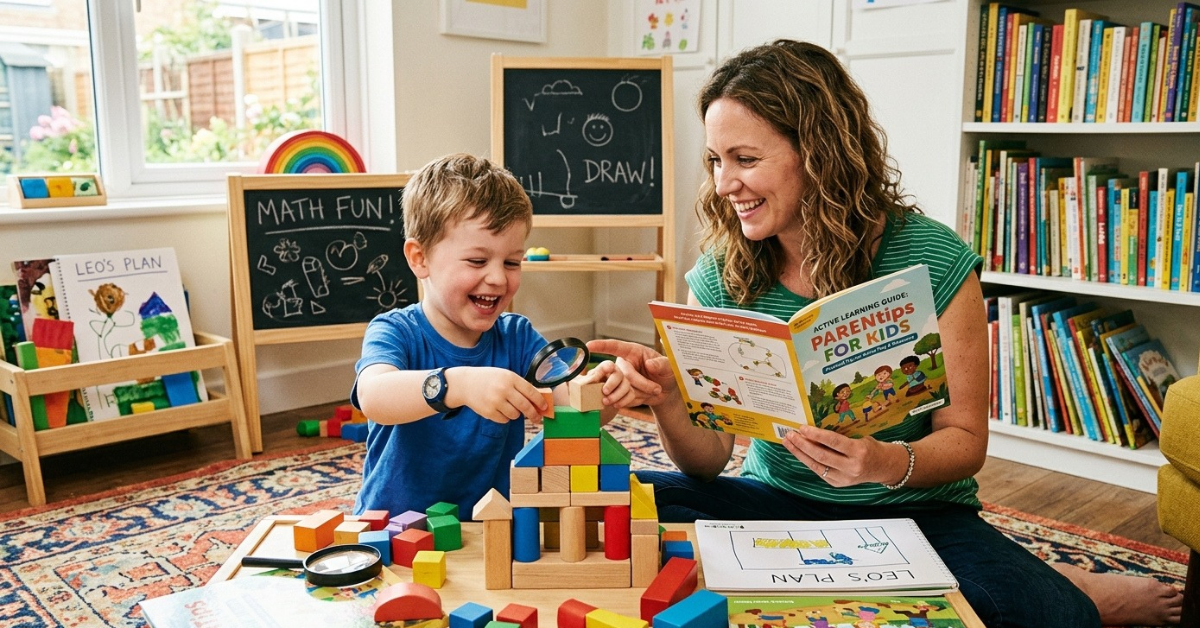
Learning does not always look like a child sitting quietly with a book. Sometimes it looks like building a tower that keeps falling, asking “why?” for the tenth time, measuring ingredients in the kitchen, or figuring out how to make a paper airplane fly farther.
That is the idea behind the active learning guide FParentips: helping children learn through participation, exploration, questions, play, and real-world experiences. Instead of simply giving children information, active learning encourages them to interact with it.
Research supports this approach. A large meta-analysis of 225 studies found that active learning improved student performance compared with traditional lecturing, while other research has found benefits for learning achievement and retention in K–12 settings.
The good news? Parents do not need expensive educational equipment or a perfectly organized learning room. Many active learning opportunities are already hiding inside everyday family life.
What Is Active Learning?
Active learning is an approach in which children participate directly in the learning process instead of only listening, watching, or memorizing.
A child might:
- Ask questions about something they notice
- Experiment to see what happens
- Build or create something
- Solve a puzzle or problem
- Explain their reasoning
- Discuss a story
- Make predictions
- Connect new information to everyday experiences
The important part is engagement. Children are not simply receiving information; they are doing something with it.
For example, reading about plants is useful, but planting a seed and observing its growth creates another layer of learning. The child can make predictions, record changes, ask questions, and discover that plants need particular conditions to grow.
Why Active Learning Matters for Children
Active learning is not simply about making education more entertaining. It can encourage deeper thinking and give children opportunities to practice using what they know.
A 2014 meta-analysis covering 225 undergraduate STEM studies found that students in active-learning environments performed better on assessments than students in traditional lecture settings. The study also found lower failure rates in active-learning classes.
Research focused specifically on K–12 education has also reported positive effects on academic achievement and learning retention, although the size of the effect varies across studies and educational settings.
Builds Problem-Solving Skills
When children face a challenge without an immediate answer, they have to think about what they already know and decide what to try next.
A simple building challenge can demonstrate this beautifully. If a block tower keeps falling, a child may experiment with its base, change the arrangement, or use different materials.
The lesson is bigger than building blocks. They are practicing trial and error.
Encourages Curiosity
Children naturally ask questions. Instead of answering every question immediately, parents can sometimes turn those questions into opportunities for exploration.
If a child asks, “Why does ice melt?” you could explain it, but you could also place ice in different locations and ask the child to observe what happens.
That small change turns a question into an investigation.
Supports Confidence and Independence
Successfully working through a problem can give children confidence in their own abilities.
This does not mean letting them struggle endlessly. It means giving them reasonable opportunities to attempt something before immediately solving it for them.
A helpful response might be:
“What do you think we should try next?”
That keeps the child involved rather than making the parent the automatic problem-solver.
How Parents Can Create an Active Learning Environment
You do not need to transform your entire home into a classroom.
Instead, create an environment where children can safely explore, ask questions, and access simple materials.
1. Create a Curiosity-Friendly Space
A small area with accessible materials can become a mini exploration zone.
Depending on the child’s age, it might contain:
- Building blocks
- Paper and crayons
- Puzzles
- Measuring cups
- Books
- Magnifying glasses
- Recyclable boxes
- Simple craft supplies
- Age-appropriate science materials
The goal is not to fill the room with toys. Open-ended materials are often more useful because children can use them in multiple ways.
2. Ask Open-Ended Questions
Questions are one of the easiest tools parents can use.
Instead of asking only questions with one correct answer, try prompts such as:
- “What do you think will happen?”
- “Why do you think that happened?”
- “How could we solve this?”
- “What else could we try?”
- “What did you notice?”
- “How would you change it?”
These questions encourage children to explain their thinking rather than simply recall an answer.
Carnegie Mellon University’s teaching guidance similarly highlights active generation, practice, and feedback as important components of active learning.
Active Learning Activities by Age
The best activity depends on the child’s developmental stage. Something fascinating for a preschooler may be far too simple for an older child.
Active Learning for Toddlers
Toddlers learn heavily through sensory experiences, movement, imitation, and simple cause-and-effect activities.
Try:
- Sorting objects by color
- Stacking cups
- Pouring water between containers
- Matching socks
- Looking for objects during a nature walk
- Naming household objects
- Making simple sounds with safe kitchen objects
For example, sorting laundry can become a surprisingly useful learning activity. Ask your toddler to separate light and dark clothing or match pairs of socks.
You get a little help, and they practice classification.
Active Learning for Preschoolers
Preschoolers can begin handling simple predictions, experiments, stories, and creative challenges.
Try:
- Sink-or-float experiment: Ask the child to predict whether household objects will sink or float.
- Seed experiment: Plant a seed and observe changes each day.
- Story prediction: Pause during a story and ask what might happen next.
- Building challenge: Ask the child to build a bridge for a toy.
- Shape hunt: Look around the house for circles, squares, triangles, and rectangles.
The activity does not have to be complicated. The conversation surrounding it is often where much of the learning happens.
Active Learning for School-Aged Children
Older children can handle more complex challenges and real-world applications.
Try:
- Cooking from a recipe
- Creating a household budget
- Planning a walking route
- Measuring furniture
- Building a model
- Designing a simple experiment
- Researching an animal or historical topic
- Creating a presentation about something they enjoy
Cooking is particularly useful because it naturally combines mathematics, reading, sequencing, and science.
A recipe can turn fractions into something tangible: half a cup is no longer just a number on a worksheet.
Turn Everyday Tasks Into Learning Opportunities
One of the most useful ideas in the active learning guide FParentips is that learning does not have to happen during a designated “study hour.”
Everyday routines can become learning opportunities.
Grocery Shopping
At the store, children can:
- Count items
- Compare quantities
- Identify shapes and colors
- Read labels
- Compare prices
- Discuss different foods
Older children can even help calculate the approximate cost of several items.
Cooking
Cooking offers opportunities to practice:
- Measurement
- Fractions
- Reading
- Following instructions
- Time management
- Observation
- Basic scientific concepts
Ask questions while cooking rather than turning the activity into a lecture.
“What do you think will happen when we heat this?”
Now the child has something to investigate.
Outdoor Exploration
A walk around the neighborhood can become a science and observation activity.
Ask children to notice:
- Different types of leaves
- Weather changes
- Insects
- Birds
- Building shapes
- Sounds
- Shadows
- Signs and numbers
The world itself becomes the classroom.
Learning Through Games
Games can make active learning feel less like formal education.
Useful options include:
- Board games
- Memory games
- Word games
- Puzzles
- Building challenges
- Treasure hunts
- Strategy games
- Educational digital games
The important thing is not whether a game has the word “educational” on its packaging. Look at what the child actually does while playing.
Does the activity require decisions, reasoning, communication, memory, creativity, or problem-solving?
If so, it may provide meaningful opportunities for active engagement.
Using Technology Without Making Learning Passive
Technology can support active learning, but simply putting an educational video on a screen does not automatically make the experience active.
The difference often comes from what happens around the technology.
For example:
Passive approach:
A child watches a video about volcanoes and moves on to another video.
Active approach:
The child watches the video, writes down questions, creates a simple model, discusses how volcanoes work, and researches a related question.
The second experience requires more participation.
Recent research on active-learning strategies in educational videos found positive effects on retention, comprehension, transfer, and motivation, although outcomes varied depending on learner and video characteristics.
Make Screen Time Interactive
Parents can ask:
- “What did you learn?”
- “What surprised you?”
- “Can you explain that to me?”
- “What would happen if…?”
- “Can we try something similar ourselves?”
This turns digital content into a starting point for conversation and exploration.
The Parent’s Role: Guide, Don’t Always Rescue
One of the biggest adjustments in active learning is changing how adults respond when children encounter difficulty.
It can be tempting to immediately say, “Here, let me do it.”
But sometimes children need a little room to work through a problem.
Instead, try:
- Give the child time to attempt the task.
- Ask what they have already tried.
- Offer a small hint if necessary.
- Let them test their idea.
- Discuss what happened afterward.
This approach helps children see mistakes as information rather than proof that they cannot do something.
Encourage Productive Struggle
Struggling with a difficult puzzle or failed experiment is not necessarily a bad thing.
Reasonable challenges can encourage children to:
- Try another strategy
- Learn from mistakes
- Think critically
- Persist with a task
- Evaluate what worked
- Ask for appropriate help
Of course, the challenge should be suitable for the child’s age and ability. The goal is not frustration for its own sake.
It is about finding that sweet spot where a child thinks, “This is difficult, but maybe I can figure it out.”
Active Reading for Better Comprehension
Reading does not have to be passive either.
After reading a story, ask children to:
- Predict what happens next
- Explain why a character made a decision
- Describe their favorite part
- Retell the story
- Create an alternative ending
- Connect the story to something in their own life
For younger children, even asking, “What do you see in this picture?” can encourage observation and communication.
The more children interact with what they read, the more opportunities they have to process and explain the information.
Common Mistakes Parents Should Avoid
Active learning works best when it remains enjoyable and manageable.
Trying to Teach Everything
You do not need to turn every activity into a lesson.
Sometimes children simply need to play.
The goal is to recognize natural learning opportunities, not force an academic objective into every five minutes of the day.
Giving Answers Too Quickly
If a child asks a question, answering is perfectly fine. But sometimes responding with another question can encourage deeper thinking.
Instead of:
“You should put this block here.”
Try:
“What happens if we put the bigger block underneath?”
Making Activities Too Complicated
Pinterest can make parenting look like a full-time arts-and-crafts production company.
It doesn’t have to be that way.
A cardboard box, a few crayons, and a curious child can be enough.
Focusing Only on Correct Answers
Active learning is about the process as well as the result.
Praise useful behaviors such as:
- “You tried a different idea.”
- “You noticed something important.”
- “You kept working on it.”
- “That’s an interesting explanation.”
- “What made you choose that approach?”
This keeps attention on thinking and learning rather than only getting everything right.
A Simple Active Learning Routine
If you are not sure where to begin, keep it extremely simple.
Try this five-step routine:
- Notice: Pay attention to what interests your child.
- Ask: Use an open-ended question.
- Explore: Let the child investigate.
- Discuss: Talk about what happened.
- Connect: Relate the experience to something familiar.
For example, if your child notices a puddle after rain, ask why the puddle is there. Let them observe it throughout the day. Discuss evaporation and connect it to wet clothes drying.
That is active learning without a worksheet in sight.
Frequently Asked Questions
What is the active learning guide FParentips?
The active learning guide FParentips is a parent-focused approach to encouraging children to participate actively in learning through exploration, questions, play, problem-solving, and everyday experiences.
What are examples of active learning at home?
Simple examples include cooking, building with blocks, conducting age-appropriate experiments, sorting objects, reading and discussing stories, solving puzzles, gardening, and exploring outdoors.
Why is active learning important for children?
Active learning gives children opportunities to apply knowledge, solve problems, communicate ideas, and think through challenges. Research has found positive effects on learning outcomes across several educational contexts.
Can active learning be used with technology?
Yes. Interactive educational apps, digital experiments, educational videos, and research activities can support active learning when children are encouraged to think, respond, create, and discuss rather than simply watch.
How can parents encourage active learning?
Parents can ask open-ended questions, provide accessible materials, encourage curiosity, allow children to attempt reasonable challenges, and connect learning to everyday activities.
Does active learning require expensive educational toys?
No. Many useful activities can be created with household objects, books, recyclable materials, kitchen ingredients, outdoor environments, or simple games.
Conclusion
The active learning guide FParentips is built around a straightforward idea: children learn by participating.
You do not need to create a complicated homeschool curriculum or fill your house with educational gadgets. Start with what you already have. Ask a question while cooking, let your child investigate something they noticed outside, turn a puzzle into a problem-solving challenge, or discuss a story after reading it.
The research behind active learning provides strong support for meaningful participation, while the everyday examples make the approach practical for families.
Most importantly, remember that learning does not have to feel like work every minute. Give children opportunities to explore, make mistakes, ask questions, and discover things for themselves.
Sometimes the best lesson starts with a very simple question: “What do you think will happen?”



Leave a Reply