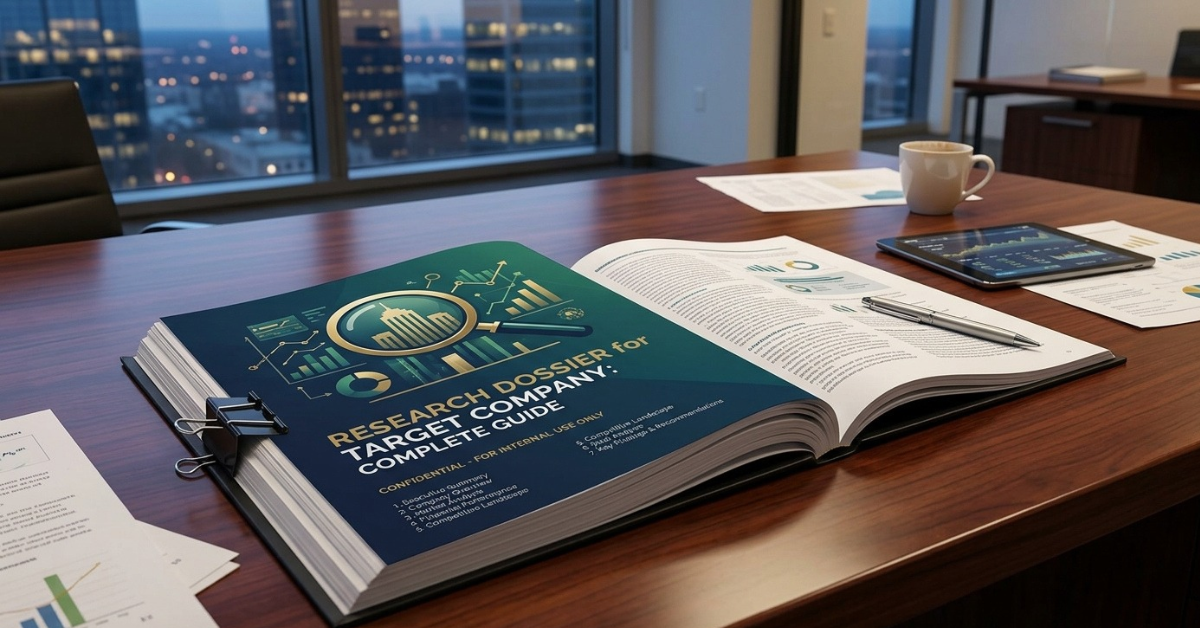
Before applying for a job, pitching a client, investing in a business, or entering a new market, it helps to know exactly who you are dealing with. That is where a research dossier for target company becomes useful.
- What Is a Research Dossier for a Target Company?
- Why Is a Company Research Dossier Important?
- What Should a Target Company Research Dossier Include?
- Target Market and Customer Analysis
- Competitor Research
- Market and Industry Analysis
- Leadership and Management Research
- Financial and Business Performance
- Company News and Recent Developments
- SWOT Analysis for a Target Company
- How to Research a Target Company
- Common Mistakes to Avoid
- A Simple Research Dossier Structure
- Research Dossier vs. Company Profile
- FAQs About Research Dossiers
- Conclusion
A research dossier brings important information about a company into one organized document. Instead of jumping between websites, reports, social media pages, news articles, and databases, you can collect the most relevant details in a structured format and use them to make better-informed decisions.
Whether you are researching a potential employer, competitor, supplier, client, or business partner, a well-prepared company research dossier can turn scattered information into a clear picture.
What Is a Research Dossier for a Target Company?
A research dossier for target company is a structured collection of information about a specific business or organization.
It normally combines basic company information with deeper research into areas such as:
- Company history
- Products and services
- Target customers
- Leadership and management
- Business model
- Competitors
- Market position
- Recent developments
- Online presence
- Financial information, when publicly available
- Strengths and challenges
- Industry trends
- Potential risks and opportunities
The exact contents depend on why the research is being conducted. A job seeker, for example, may focus on company culture and recent projects, while a sales professional may concentrate on products, decision-makers, customers, and business needs.
Why Is a Company Research Dossier Important?
Good research saves time, but its bigger advantage is context.
A company might describe itself as innovative, customer-focused, or market-leading. A dossier allows you to look beyond those descriptions and examine the evidence available from different sources.
A strong dossier can help you:
- Understand the company — Learn what it does and how it operates.
- Identify competitors — See which businesses serve similar customers.
- Understand the market — Connect the company to wider industry trends.
- Spot opportunities — Identify areas where the company may be expanding or changing.
- Recognize potential risks — Consider factors that could affect its operations.
- Prepare for decisions — Use organized information instead of relying on assumptions.
What Should a Target Company Research Dossier Include?
There is no single format that works for every situation. However, most useful dossiers contain several core sections.
1. Company Overview
Begin with the basics. This section gives readers a quick understanding of the organization.
Include information such as:
- Company name
- Founding year
- Headquarters
- Industry
- Ownership structure
- Main products or services
- Geographic markets
- Official website
- Parent company or subsidiaries, if relevant
Keep this section concise. The goal is to establish context before moving into deeper analysis.
2. Company History and Background
The company’s history can explain how it reached its current position.
Research major milestones such as:
- Founding and early development
- Major product launches
- Acquisitions or mergers
- Expansion into new markets
- Rebranding
- Major partnerships
- Leadership changes
- Significant business developments
A timeline can make this section particularly easy to understand.
3. Products and Services
Next, examine what the company actually sells or provides.
For each major product or service, consider:
- What problem does it solve?
- Who uses it?
- What makes it different?
- How is it priced, if pricing is public?
- Which markets does it serve?
- What alternatives are available?
This helps transform a simple product list into meaningful business research.
Target Market and Customer Analysis
Understanding the customer is one of the most important parts of a research dossier for target company.
Look at the company’s apparent target audience and consider factors such as:
- Customer demographics
- Business-to-business or business-to-consumer focus
- Geographic markets
- Customer needs
- Purchasing behavior
- Typical use cases
- Customer retention strategies
Public reviews, customer case studies, product documentation, and company publications can sometimes provide useful clues.
However, avoid treating a handful of online reviews as representative of the entire customer base. Small samples can create a misleading picture.
Competitor Research
No company operates in isolation. Competitor analysis adds valuable context to your dossier.
Start by identifying direct competitors. These businesses generally offer similar products or services to the same customer group.
Then consider indirect competitors. These may solve the same customer problem through a different product, service, or business model.
For each major competitor, compare:
| Factor | Target Company | Competitor |
| Main offering | Product/service | Product/service |
| Target customers | Customer group | Customer group |
| Geographic reach | Relevant markets | Relevant markets |
| Pricing | If publicly available | If publicly available |
| Differentiation | Key characteristics | Key characteristics |
| Recent developments | Major updates | Major updates |
The purpose is not simply to create a list of competitors. It is to understand how the businesses operate within the same market.
Market and Industry Analysis
Company research becomes much more useful when you connect it to the wider industry.
Research current factors that could affect the organization, including:
- Market growth or contraction
- Consumer behavior
- Technology changes
- New regulations
- Economic conditions
- Supply-chain issues
- Emerging competitors
- Changing customer expectations
Industry associations, government publications, regulatory bodies, academic research, and established business publications can be useful sources.
Leadership and Management Research
Leadership can provide additional context about a company’s direction.
Depending on the purpose of your research, investigate:
- CEO and senior executives
- Founders
- Board members
- Major leadership changes
- Relevant professional backgrounds
- Publicly stated strategic priorities
Be careful with personal information. A professional research dossier should focus on information that is relevant to the company’s operations rather than unnecessary private details.
Financial and Business Performance
When reliable public information is available, financial research can add another layer to the dossier.
Potential information includes:
- Revenue
- Profit or loss
- Funding
- Valuation
- Market capitalization
- Major investments
- Debt
- Annual reports
- Earnings announcements
Not every company publishes detailed financial information. Private businesses, in particular, may provide limited figures.
In those cases, clearly distinguish between verified financial information and third-party estimates.
Company News and Recent Developments
A dossier should not rely entirely on old information.
Search for recent developments involving:
- New products
- Expansion
- Partnerships
- Funding announcements
- Acquisitions
- Major contracts
- Regulatory issues
- Lawsuits
- Executive appointments
- Closures or restructuring
Adding publication dates to important findings makes it easier to understand how current the information is.
SWOT Analysis for a Target Company
A SWOT analysis can summarize the research in a simple format.
Strengths
These are internal characteristics that may support the company’s position, such as:
- Strong brand recognition
- Established customer base
- Proprietary technology
- Broad distribution
- Experienced leadership
Weaknesses
These are internal limitations that may create challenges.
Examples can include:
- Limited geographic coverage
- Dependence on a small number of products
- Operational constraints
- High costs
Opportunities
These are external developments that could create potential growth opportunities.
Examples include:
- Emerging markets
- New customer segments
- Technological developments
- Product expansion
Threats
These are external factors that could negatively affect the business.
Examples include:
- New competitors
- Regulatory changes
- Economic pressure
- Changing customer preferences
Remember that SWOT findings are analytical interpretations. They should be supported by evidence wherever possible rather than presented as unquestionable facts.
How to Research a Target Company
Creating a dossier does not have to be complicated. A systematic process usually produces better results than randomly collecting information.
Step 1: Define the Research Objective
First, determine why you are researching the company.
For example, your objective might be:
- Preparing for a job interview
- Evaluating a potential client
- Conducting competitor research
- Preparing an investment report
- Studying a potential supplier
- Understanding a business for a marketing project
Your objective determines which information deserves the most attention.
Step 2: Start With Primary Sources
Whenever possible, begin with information published directly by the company.
Useful sources include:
- Official company website
- Investor relations pages
- Annual reports
- Regulatory filings
- Official press releases
- Product documentation
- Company announcements
Primary sources are particularly useful for confirming basic company facts and official statements.
Step 3: Check Independent Sources
Do not stop at the company’s own website.
Use independent sources to add context, such as:
- Government databases
- Industry publications
- Established news organizations
- Academic research
- Trade associations
- Regulatory records
Comparing multiple sources can help identify inconsistencies or outdated information.
Step 4: Record Sources as You Research
Do not wait until the end to remember where everything came from.
For each important finding, record:
- Source name
- URL or publication
- Publication date
- Information collected
- Date accessed
This makes the final dossier easier to verify and update.
Step 5: Separate Facts From Analysis
This is a small step that makes a huge difference.
For example:
Fact: The company announced the opening of a new regional office in 2026.
Analysis: The expansion may indicate an increased focus on that market.
The first statement can be verified directly. The second is an interpretation and should be presented as such.
Common Mistakes to Avoid
Even a detailed company dossier can become unreliable if the research process is weak.
Avoid these common mistakes:
Relying on a Single Source
One website rarely provides the complete picture. Cross-check important claims.
Using Outdated Information
Company leadership, products, prices, partnerships, and market conditions can change quickly.
Confusing Marketing With Evidence
Corporate websites are useful primary sources, but promotional language should not automatically be treated as objective evidence.
Ignoring the Research Date
Always indicate when the research was conducted. A dossier can become outdated surprisingly quickly.
Adding Unverified Claims
If a claim cannot be confirmed through a credible source, label it appropriately or leave it out.
Making the Dossier Too Long
More information does not automatically mean better research. Include information that supports the purpose of the dossier.
A Simple Research Dossier Structure
If you need to create one from scratch, this structure is a useful starting point:
- Executive Summary
- Company Overview
- Company History
- Products and Services
- Target Market
- Business Model
- Leadership
- Competitor Analysis
- Industry Overview
- Financial Information
- Recent News and Developments
- SWOT Analysis
- Risks and Opportunities
- Key Findings
- Sources and References
You can expand or shorten these sections depending on the research objective.
Research Dossier vs. Company Profile
These terms are sometimes used interchangeably, but they can serve different purposes.
A company profile usually provides a concise overview of an organization. It may cover its history, products, services, location, and basic business information.
A research dossier is generally broader and more analytical. It can combine company information with competitors, market research, recent developments, risks, financial information, and source documentation.
In simple terms, a company profile tells you what the company is, while a research dossier can explore what the company does, where it sits in its market, and what relevant evidence says about it.
FAQs About Research Dossiers
What is a research dossier for a target company?
It is an organized collection of researched information about a specific company. It can include company background, products, competitors, market conditions, leadership, financial information, recent developments, and risks.
What is the purpose of a company research dossier?
Its purpose is to bring relevant information together so that a person can understand a company and its business environment more effectively.
How long should a research dossier be?
There is no fixed length. A short company assessment might be a few pages, while detailed competitive or market research can be substantially longer. Relevance and source quality matter more than page count.
What sources should be used for company research?
Start with primary sources such as official company websites, regulatory filings, annual reports, and press releases. Then use credible independent sources to provide additional context.
Should financial information be included?
If financial information is publicly available and relevant to the research objective, it can be included. Clearly identify whether figures are reported by the company, provided by a regulator, or estimated by a third party.
Can a research dossier include SWOT analysis?
Yes. SWOT analysis is commonly used to organize findings into strengths, weaknesses, opportunities, and threats. The individual points should be based on evidence and clearly distinguished from interpretation.
How often should a company research dossier be updated?
It depends on the purpose. For fast-changing industries, important sections may need frequent updates. At minimum, record the research date and review major company developments before relying on an older dossier.
Conclusion
A research dossier for target company is more than a collection of facts. When prepared carefully, it creates a structured view of a company’s background, products, customers, competitors, market environment, recent developments, and potential challenges.
The most reliable approach is straightforward: define your research goal, use credible primary and independent sources, cross-check important information, separate facts from analysis, and keep track of publication dates.
Whether you are preparing for an interview, studying a competitor, evaluating a business relationship, or conducting market research, a well-organized dossier gives you a much clearer starting point. Once the basic structure is in place, you can also update it whenever important company or industry developments occur.

Leave a Reply