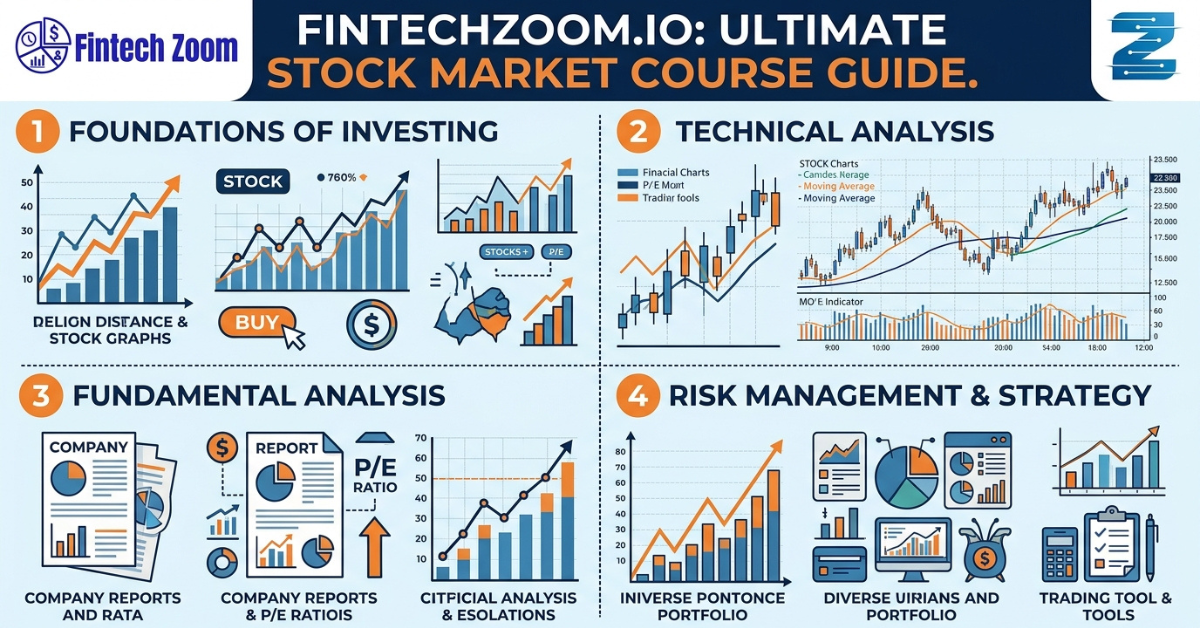
Learning the stock market can feel like learning a new language. Stocks, ETFs, candlestick patterns, portfolio allocation, risk management, and market psychology can quickly become overwhelming when you’re starting from scratch.
That’s where a structured course can help. The fintechzoom.io stock market course is a search term attracting attention from people looking for an organized way to learn trading and investing. FintechZoom.io currently lists separate courses for Stock Market Trading and Stock Market Investing, alongside a broader financial literacy course.
However, there is an important detail prospective students should understand before signing up: information about the .io website and its relationship with the FintechZoom brand is not straightforward. So rather than treating every claim online as fact, it makes sense to look at what the course pages actually say and what should be independently verified.
What Is the FintechZoom.io Stock Market Course?
The phrase “FintechZoom.io stock market course” can be slightly misleading because it does not appear to refer to just one course.
FintechZoom.io’s courses page currently lists three educational areas:
- Financial Literacy
- Stock Market Trading
- Stock Market Investing
The trading program is presented as the Stock Market Trading Mastery Course, while the investing program is presented as the FintechZoom Investment Mastery Course.
The two stock-market courses have different purposes. Trading focuses more heavily on market movements, technical analysis, trading styles, and risk management. Investing is broader and focuses on portfolio construction, asset allocation, diversification, and longer-term investment concepts.
That distinction matters because someone looking to build a retirement portfolio has very different learning needs from someone interested in short-term trading.
FintechZoom.io Stock Market Trading Course
The trading course is designed for new traders, intermediate traders, and working professionals, according to the course page.
Its listed topics include:
- Stock-market fundamentals
- Candlestick patterns
- Price trends
- Day trading
- Swing trading
- Position trading
- Stop-loss strategies
- Portfolio allocation
- Trading psychology
- Market indicators
- Options and forex
- Algorithmic trading
- Margin trading
- Trading apps and software
- The effect of news and global events on markets
The course page also says it includes 4–6 hours of on-demand video lessons, practical resources such as charts and strategy guides, interactive quizzes, and a certificate of completion.
That’s a fairly broad list for a relatively short course. In practical terms, students should think of this as an introduction to a wide range of subjects rather than assuming that several hours of video will create professional-level expertise in every area.
What Does the Trading Course Teach?
The curriculum combines several major areas of trading education.
Technical analysis covers concepts such as candlestick patterns, trends, price movements, and market indicators. These are commonly used by traders to interpret historical and current price data.
Trading styles are another part of the program. Day trading, swing trading, and position trading involve different holding periods and approaches to market participation.
Risk management is particularly important. Stop-loss techniques, portfolio allocation, and managing exposure can help traders understand that protecting capital is an essential part of participating in financial markets.
The course also discusses trading psychology, which is relevant because emotions such as fear, greed, impatience, and overconfidence can affect decision-making.
FintechZoom.io Investment Course
The investing course takes a different approach.
FintechZoom.io describes the Investment Mastery Course as suitable for beginner investors, intermediate investors, and working professionals. The listed curriculum covers both traditional investments and broader portfolio-management concepts.
Topics listed on the course page include:
- Stocks and equities
- Bonds
- Mutual funds
- ETFs
- Real estate
- Alternative investments
- Asset allocation
- Diversification
- Value investing
- Dividend-growth investing
- Passive index strategies
- Portfolio rebalancing
- Hedging
- Market indicators
- International investing
- ESG investing
- Investment psychology
- Options and futures
- Robo-advisers
- Artificial intelligence and investing
- Wealth preservation
The investment course page states that it provides 7–8 hours of on-demand lessons, printable worksheets, interactive quizzes, and a certificate.
Again, the breadth is worth noticing. Covering many investment categories can be useful for someone building foundational knowledge, but readers should not confuse exposure to a topic with advanced expertise.
Trading vs. Investing: Which Topics Are Different?
One of the easiest ways to understand the two programs is to look at their general focus.
| Trading Course | Investing Course |
| Shorter-term market activity | Longer-term wealth building |
| Candlestick patterns | Asset classes |
| Day trading | Portfolio allocation |
| Swing trading | Diversification |
| Position trading | ETFs and mutual funds |
| Stop-loss strategies | Bonds and equities |
| Trading psychology | Investment psychology |
| Market indicators | Economic indicators |
| Algorithmic trading introduction | Passive investing |
| Margin trading | Rebalancing and hedging |
These aren’t rigid categories. Long-term investors can use technical analysis, and traders need risk management too. The difference is mainly the emphasis of each course.
Course Features and Learning Format
FintechZoom.io promotes several features across its course offerings.
Self-Paced Learning
The courses are presented as self-paced programs, meaning learners can study according to their own schedule.
That can be particularly convenient for students, employees, and beginners who don’t want to follow fixed classroom hours.
Video Lessons
The stock-market programs use on-demand video lessons. The trading course lists approximately 4–6 hours, while the investing course lists approximately 7–8 hours.
Quizzes and Practical Resources
The course pages also mention quizzes, exercises, worksheets, charts, and strategy guides.
These types of materials can be useful because financial concepts are easier to understand when you can apply them rather than simply watching a video and moving on.
Certificate
Both stock-focused course pages advertise certificates after completion.
However, a certificate of course completion should not automatically be interpreted as professional accreditation, a financial license, or proof of trading ability. Anyone considering the course for career purposes should check exactly what the certificate represents.
What Should You Verify Before Paying?
This is arguably the most important part of researching the fintechzoom.io stock market course.
The public course pages provide descriptions and topic lists, but prospective students should still confirm important purchasing details directly before providing payment information.
1. Confirm the Current Price
The publicly accessible course pages reviewed for this article do not clearly display a standard course price.
Ask for the exact amount you will pay, including taxes or additional charges if applicable.
2. Ask Who Teaches the Course
The site describes guidance from industry experts, but prospective students should request specific instructor information and credentials before relying on that description.
Useful questions include:
- Who created the curriculum?
- Who teaches the lessons?
- What professional experience do the instructors have?
- Can their credentials be independently verified?
3. Request the Complete Syllabus
A topic list is helpful, but a detailed module-by-module syllabus gives you a much clearer idea of what you’re buying.
Look for information about lesson objectives, assignments, practical exercises, and how much time is devoted to each subject.
4. Check the Refund Policy
Before purchasing any online financial course, understand:
- Whether refunds are available
- The refund period
- Whether there are conditions attached
- How a refund request must be submitted
- Whether access ends immediately after a refund
Getting these details in writing is preferable.
A Note About the FintechZoom Name
There is an especially important branding issue here.
FintechZoom.com identifies FintechZoom.com as its official domain and explicitly lists fintechzoom.io among domains it says are not affiliated with its organization. The .com site’s warning describes those domains as impersonating FintechZoom.
At the same time, fintechzoom.io is publicly accessible and has its own course pages under the FintechZoom name.
Because these claims conflict, readers should not automatically assume that a course advertised on fintechzoom.io is an official FintechZoom.com product.
This is more than a minor technicality. When a course involves financial education and potentially payment information, verifying who operates the website is an important part of due diligence.
Before enrolling, independently confirm:
- Who operates the
.iowebsite. - Whether it has any relationship with FintechZoom.com.
- Who will process your payment.
- What organization is responsible for the course.
- What refund and support arrangements apply.
Is the FintechZoom.io Stock Market Course Suitable for Beginners?
Based on the published curriculum, the courses are explicitly aimed at beginners as well as people with more experience.
A beginner may find a structured curriculum easier to follow than jumping between unrelated videos, social-media posts, and trading forums.
Still, beginners should keep expectations realistic.
A course can teach you what a P/E ratio means, how candlestick charts work, or why diversification matters. It cannot eliminate market risk or guarantee that you’ll make money.
A sensible learning path is:
- Learn basic financial terminology.
- Understand how stocks, ETFs, and other assets work.
- Study risk and portfolio management.
- Learn how to read financial information.
- Practice without risking significant capital.
- Develop a written investment or trading plan.
- Continue studying before making larger financial decisions.
Does Completing a Stock Market Course Guarantee Profits?
No.
This is one of the most important points for anyone researching online trading education.
Stock prices can rise or fall, and even experienced market participants can lose money. Learning technical analysis or investment strategies does not remove uncertainty.
Be particularly careful with any advertisement that suggests a course can guarantee specific profits, eliminate losses, or accurately predict future market movements.
A legitimate financial education course should help you understand risk rather than pretend risk doesn’t exist.
How to Evaluate Any Stock Market Course
You don’t have to apply this checklist only to FintechZoom.io. It works for almost any online trading or investing course.
Before Enrolling
Check:
- Instructor credentials: Are the instructors named and independently verifiable?
- Curriculum: Is there a detailed syllabus?
- Course length: How much actual educational content is included?
- Practical work: Are there exercises, examples, or simulations?
- Pricing: Is the total cost clearly disclosed?
- Refund policy: Are the conditions easy to understand?
- Updates: Is the material updated when markets and regulations change?
- Certificate: Is it simply a completion certificate or an independently recognized credential?
- Security: Are the website and payment process trustworthy?
- Brand identity: Is the organization clearly identified?
This takes a few minutes but can save you from paying for something that doesn’t match your expectations.
FintechZoom.io Stock Market Course: Key Takeaways
The fintechzoom.io stock market course search term generally leads to information about two stock-focused programs: Stock Market Trading and Stock Market Investing.
The trading course emphasizes areas such as technical analysis, trading styles, risk management, market psychology, and trading tools. The investing course covers asset classes, diversification, portfolio construction, investing strategies, and broader wealth-management concepts.
The public pages also advertise self-paced video learning, quizzes, practical materials, and certificates.
The bigger issue is verification. Because FintechZoom.com says that fintechzoom.io is not affiliated with it, prospective students should establish exactly who operates the .io course before paying or submitting sensitive information.
In other words, focus not only on what the course teaches, but also on who is actually behind it.
FAQs About the FintechZoom.io Stock Market Course
What is the FintechZoom.io stock market course?
It is a term commonly used for the stock-market education programs listed on fintechzoom.io. The site currently lists separate Stock Market Trading and Stock Market Investing courses.
Is the FintechZoom.io stock market course for beginners?
Yes. The published course pages specifically identify new traders and beginner investors among their intended audiences.
How long is the FintechZoom.io trading course?
The Stock Market Trading course currently states that it includes approximately 4–6 hours of on-demand video lessons.
How long is the FintechZoom.io investing course?
The Stock Market Investing course currently states that it contains approximately 7–8 hours of on-demand lessons.
Does the course include a certificate?
Yes. Both the trading and investing course pages advertise a certificate after completion.
Does the course guarantee stock market profits?
No course should be treated as a guarantee of investment or trading profits. Market outcomes are uncertain, and financial losses remain possible.
Is fintechzoom.io the same as fintechzoom.com?
They should not automatically be treated as the same organization. FintechZoom.com states that fintechzoom.io is not affiliated with it and lists the .io domain in a warning about sites it says impersonate FintechZoom.
What should I check before buying the course?
Confirm the operator, instructor credentials, complete syllabus, current price, payment terms, refund policy, certificate details, and customer-support arrangements before enrolling.
Can a stock market course replace professional financial advice?
No. Educational material can help you understand markets, but it does not replace advice tailored to your financial circumstances, tax situation, objectives, or risk tolerance.
Conclusion
The fintechzoom.io stock market course offers a broad introduction to trading and investing through separate educational programs. Its published material covers useful subjects ranging from technical analysis and trading psychology to diversification, asset allocation, ETFs, and portfolio management.
For anyone considering enrollment, however, the course content is only part of the research. The conflicting information about the relationship between fintechzoom.io and FintechZoom.com makes it particularly important to verify the operator, instructor credentials, pricing, refund terms, and payment details before committing money.
If you’re new to investing, use the course information as a starting point rather than a promise of financial results. Learn the fundamentals, understand risk, practice what you learn, and verify the organization behind any paid financial education product before taking the next step.

Leave a Reply