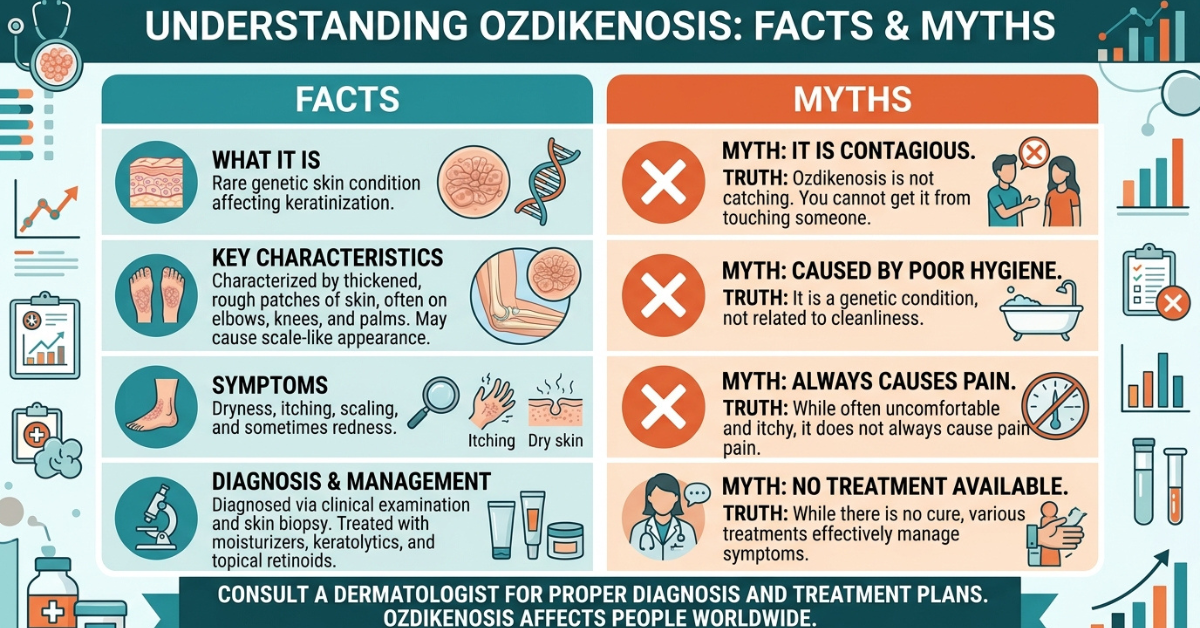
If you have searched what to know about Ozdikenosis, you may have noticed something unusual: plenty of websites talk about it, but they do not agree on what it actually is.
- What Is Ozdikenosis?
- Is Ozdikenosis a Real Disease?
- Why Does Ozdikenosis Sound Like a Medical Condition?
- What Are the Symptoms of Ozdikenosis?
- What Causes Ozdikenosis?
- Are There Different Stages of Ozdikenosis?
- Can Ozdikenosis Be Fatal?
- Is There a Treatment for Ozdikenosis?
- Why Is Ozdikenosis Appearing Online?
- How to Fact-Check an Unfamiliar Medical Term
- What Should You Do If You Have Symptoms?
- Ozdikenosis vs. Verified Medical Information
- Frequently Asked Questions About Ozdikenosis
- Final Takeaway: What to Know About Ozdikenosis
That is a major clue.
At present, Ozdikenosis is not established as a recognized medical disease or diagnosis in the reliable medical evidence that can be identified. Searches for the term produce online articles making different claims about supposed symptoms, causes, progression, and even whether it can be fatal. However, those claims are not supported by an established clinical definition or a recognized body of medical research.
So, rather than treating every online description as fact, let’s look at what can actually be established.
What Is Ozdikenosis?
The simplest answer is that Ozdikenosis is an unverified term appearing in online health content.
It has been presented by some websites as though it were a rare disease, while other articles describe it as a fictional, invented, or internet-created medical term. The descriptions vary considerably, which makes it impossible to give a reliable list of symptoms or a medically accepted definition.
That distinction is important. A word appearing repeatedly in Google results does not automatically make it a medical diagnosis.
A genuine disease generally has supporting evidence such as:
- Clinical observations and documented cases
- Peer-reviewed scientific research
- An established definition
- Recognized diagnostic criteria
- Medical literature discussing its causes and progression
- Professional or institutional recognition
- Appropriate treatment or management guidance
Those foundations have not been established for Ozdikenosis based on the evidence currently available.
Is Ozdikenosis a Real Disease?
Based on the available evidence, Ozdikenosis should not be treated as a medically recognized disease.
Current online investigations into the term have found no established medical definition, accepted diagnostic criteria, or reliable scientific evidence supporting it as a recognized condition.
This is particularly important because some websites present detailed descriptions of Ozdikenosis as if the condition were already medically established. A detailed article, however, is not the same thing as clinical evidence.
Why the Difference Matters
Imagine finding five websites that all repeat the same claim. It might seem convincing.
But if those five pages are simply repeating information from one another, they do not provide five independent pieces of medical evidence.
Reliable health information should ideally be traceable to sources such as:
- Peer-reviewed research
- Medical journals
- Government health agencies
- Recognized medical institutions
- Established medical databases
- Clinical guidelines
For Ozdikenosis, that evidence base has not been demonstrated.
Why Does Ozdikenosis Sound Like a Medical Condition?
One reason the term can seem convincing is its ending.
Many legitimate medical terms contain “-osis.” Examples include fibrosis, osteoporosis, and scoliosis. The suffix is associated with various diseases or abnormal conditions, so an unfamiliar word ending in “-osis” can immediately sound medically legitimate.
But terminology alone cannot establish a disease.
A word can resemble medical language without representing an actual diagnosis. That appears to be an important part of the confusion surrounding Ozdikenosis.
What Are the Symptoms of Ozdikenosis?
There is no medically validated list of Ozdikenosis symptoms.
Some online articles associate the term with symptoms such as fatigue, weakness, cognitive problems, or other physical complaints. However, those descriptions should not be treated as an official symptom profile because the underlying condition itself has not been established through reliable medical evidence.
This does not mean that someone experiencing those symptoms is imagining them.
Fatigue, weakness, pain, changes in concentration, and other symptoms can occur for many genuine reasons. The problem is attaching those symptoms to an unverified diagnosis without proper medical evaluation.
What Causes Ozdikenosis?
There is currently no scientifically established cause of Ozdikenosis.
Online sources have proposed different explanations, but they do not provide a consistent, independently verified disease mechanism. Some websites have even connected the term with completely different biological explanations, which further demonstrates why these claims should be approached cautiously.
Until researchers establish that a condition exists and define its biological mechanism, claims about its exact cause remain speculation.
Be Careful With Detailed “Causes”
Health misinformation often becomes convincing by including very specific details.
For example, an article might claim that a particular gene, organ, toxin, infection, or environmental factor causes an unfamiliar disease. Specificity can make information sound authoritative, but it is not evidence by itself.
Always ask:
- Where did the claim originate?
- Is there published research supporting it?
- Can independent medical sources confirm it?
- Is the source actually a medical or scientific authority?
Are There Different Stages of Ozdikenosis?
There is no established medical staging system for Ozdikenosis.
Some online pages discuss supposed stages or progression patterns. However, these descriptions are not supported by a recognized clinical framework.
For a disease to have accepted stages, researchers and clinicians generally need evidence showing that the condition follows a consistent pattern of progression and that those stages have clinical meaning.
That evidence has not been established for Ozdikenosis.
Can Ozdikenosis Be Fatal?
You may have encountered searches such as “why does Ozdikenosis kill you?” or articles claiming that Ozdikenosis causes severe organ damage or death.
There is currently no verified medical evidence establishing that Ozdikenosis is a disease that causes death. Consequently, claims about an Ozdikenosis death rate, fatal progression, or specific mechanism of death should not be presented as established medical facts.
The question itself may have become popular because online articles repeatedly frame the term as a dangerous disease. Repetition can make an unverified claim appear established when it is not.
Is There a Treatment for Ozdikenosis?
There is no established, evidence-based treatment specifically for Ozdikenosis because there is no recognized clinical diagnosis under that name.
That means readers should be particularly cautious about websites offering:
- Supplements specifically marketed for Ozdikenosis
- “Cures” or detox programs
- Special diets supposedly designed for Ozdikenosis
- Unproven medications
- Alternative treatments presented as guaranteed solutions
- Paid diagnostic tests based only on the term
Taking treatment advice from an unverified diagnosis could potentially distract someone from finding the actual cause of their symptoms.
Why Is Ozdikenosis Appearing Online?
The exact origin of the word cannot currently be established with confidence.
What can be observed is that numerous websites began publishing pages around the term, often answering very similar questions. Some describe Ozdikenosis as a disease, while others explicitly question whether it exists.
This creates a feedback loop:
- Someone encounters an unfamiliar word.
- They search for its meaning.
- Websites publish articles targeting the search.
- More people see those articles.
- Additional websites publish similar content.
- The term begins to look more legitimate because it appears in many places.
But online visibility is not the same as scientific validation.
How to Fact-Check an Unfamiliar Medical Term
If you encounter Ozdikenosis or another strange medical term online, don’t panic. A few simple checks can help separate genuine health information from speculation.
1. Search medical databases
Look for the term in established biomedical literature and recognized medical databases.
A lack of results does not prove that a term can never have been used in any context, but it is an important warning sign when a supposedly established disease has no credible medical literature behind it.
2. Check recognized health organizations
Look for information from organizations such as:
- World Health Organization
- U.S. National Institutes of Health
- Centers for Disease Control and Prevention
- National Library of Medicine
- Established hospitals and academic medical centers
For Ozdikenosis, searches of major authoritative sources did not identify an established medical condition under that name.
3. Look for independent research
Be skeptical when multiple articles repeat identical claims but none provides a scientific paper, clinical study, or identifiable medical authority.
A trustworthy health article should make it possible to trace important medical claims back to evidence.
4. Watch for contradictory descriptions
This is especially relevant with Ozdikenosis.
When one website describes a condition one way and another website gives an entirely different explanation, that inconsistency is a reason to stop and verify the underlying claim rather than choosing whichever article sounds most convincing.
What Should You Do If You Have Symptoms?
If you came across Ozdikenosis because you’re experiencing unexplained symptoms, focus on the symptoms themselves, not on trying to confirm an internet diagnosis.
A healthcare professional can take your medical history, perform an examination, and determine whether testing is appropriate.
Depending on the symptoms, the underlying explanation could involve a recognized medical condition, medication effects, nutritional issues, infection, stress, or many other possibilities. Only an appropriate clinical evaluation can narrow that down.
If symptoms are severe, sudden, rapidly worsening, or potentially life-threatening, seek appropriate medical care rather than relying on online articles.
Ozdikenosis vs. Verified Medical Information
| Question | Ozdikenosis | Established medical condition |
| Recognized diagnosis | Not established | Yes |
| Consistent medical definition | No verified definition | Yes |
| Peer-reviewed evidence | No established evidence identified | Typically available |
| Diagnostic criteria | None established | Established where applicable |
| Official medical guidance | None established | Often available |
| Evidence-based treatment | None specific to the term | May be available |
| Accepted disease stages | None established | May exist for some conditions |
This comparison explains why it is important not to treat an unfamiliar internet term as equivalent to a medically diagnosed condition.
Frequently Asked Questions About Ozdikenosis
What is Ozdikenosis?
Ozdikenosis is a term appearing in online health-related content, but it is not currently established as a recognized medical diagnosis based on the available reliable evidence.
Is Ozdikenosis a real disease?
There is currently no reliable evidence establishing Ozdikenosis as a recognized disease or clinical disorder. Several websites discuss it, but online discussion alone does not establish a medical condition.
What are the symptoms of Ozdikenosis?
There is no medically validated symptom list for Ozdikenosis. Symptoms attributed to it on some websites should not be treated as an official clinical profile.
What causes Ozdikenosis?
No scientifically established cause has been identified because Ozdikenosis itself has not been established as a recognized medical condition.
Is Ozdikenosis contagious?
There is no reliable medical evidence establishing Ozdikenosis as a contagious disease.
Does Ozdikenosis have stages?
No recognized staging system exists for Ozdikenosis. Online claims describing specific stages are not supported by an established clinical framework.
Can Ozdikenosis kill you?
There is no verified evidence establishing Ozdikenosis as a disease that causes death. Claims about its fatality should therefore not be treated as established medical information.
Is there a cure for Ozdikenosis?
There is no established treatment or cure specifically for Ozdikenosis because the term does not represent a recognized medical diagnosis.
Why is Ozdikenosis trending?
The term appears to have gained attention through online articles and searches. Its medical-sounding name and conflicting descriptions may have contributed to curiosity and further searches.
Final Takeaway: What to Know About Ozdikenosis
The most important thing to know about Ozdikenosis is that its presence online should not be confused with medical recognition.
At this time, there is no established clinical definition, validated symptom profile, recognized cause, diagnostic test, staging system, or evidence-based treatment associated with Ozdikenosis. Several websites make specific claims about the term, but those claims are not supported by an established medical evidence base.
If you encountered the word because you’re worried about your health, don’t let a mysterious internet term become a self-diagnosis. Instead, write down your actual symptoms, when they started, and any relevant changes, and discuss them with a qualified healthcare professional.
And when you come across another unfamiliar medical term online, remember the golden rule: a search result is a starting point for research, not a medical diagnosis.



Leave a Reply